

















RPA vs AI Automation 2026: When to Use Each
RPA vs AI automation comparison for 2026. Decision framework with cost analysis, comparison table, hybrid approach and real-world use cases for each technology.

Reviewed by Dr. Dmytro Nasyrov, Founder and CTO • Last reviewed August 20, 2026
Pharos Production delivers Robotic Process Automation (RPA) development services that eliminate manual, repetitive tasks from your business operations.

Practice led by Dmytro Nasyrov
Founder and CTO
23+ years in custom software development. Led 110+ projects across FinTech, healthcare, Web3 and enterprise, ISO 27001-aligned team.
RPA is the right tool when there is no API and the process is stable. Direct integration is the right tool everywhere else. The wrong choice creates a maintenance burden the client did not budget for.
| Factor | RPA bot | Direct API integration |
|---|---|---|
| Reliability | Brittle to UI changes | Stable as long as the API is stable |
| Setup time | 2-6 weeks per bot | 4-12 weeks for the integration |
| Maintenance | Active monitoring required | Minimal once stable |
| When it fits | No API; stable UI; rule-based workflow | API exists; long-term scale; sensitive data |
| Cost over 3 yrs | Low setup; ongoing maintenance | Higher setup; lower maintenance |
Pharos Verified Delivery applied to RPA: every bot ships with an exception log, a recovery procedure, a version-controlled definition and a documented owner. We refuse to deploy bots that fail silently.
Pharos Verified Delivery applied to 110+ production applications since 2013
Most RPA bots break within 6 months when underlying systems change. Each bot below has been running for at least 6 months with documented uptime.
Finance team processing 800 invoices per week manually with 6% error rate.
Built an RPA bot with structured exception handling routing edge cases to humans. Error rate dropped to 0.4%; processing time cut 78%.
We did not automate every edge case. We automated the 85% that were rule-based and routed the rest to humans with full context. That hybrid is where RPA wins.
Operations team manually creating accounts in 6 internal systems for every new customer.
Bot creates accounts across all 6 systems with rollback if any fail. Onboarding time dropped from 45 minutes to 6 minutes per customer.
The hard part was the rollback. Most RPA tutorials skip rollback design. Without it, half-finished bot runs leave the systems in inconsistent states and the team loses trust.
Daily reconciliation between policy admin system and accounting taking 4-5 hours of analyst time.
Bot runs the reconciliation every morning, flagging exceptions for human review. Analyst time dropped to 25 minutes/day.
The bot did not eliminate the analyst. It freed her to investigate the exceptions, which is the work that needed her judgement anyway.
Client names anonymized under NDA. Full case studies at /cases/.
We decline roughly 30% of RFPs we receive. Forcing a bad fit costs both sides 3-6 months and damages outcomes. Here is how we think about scope:
When an API exists, we recommend a direct integration. When the process is broken, we recommend redesign first and automation second. RPA is the right tool for stable rule-based workflows across systems with no API surface, and the wrong tool everywhere else.
Portfolio observations
Observations from 9 RPA engagements 2021-2026 across FinTech, insurance, healthcare back-office and enterprise operations.
Inherited shared service accounts with admin rights on source systems. Refactoring to per-bot least-privilege credentials was the top security win every time[9].
Break rate on unmanaged programs we inherited was 22% weekly. Post refactor it held at 3-5%.
Of automations we audited had no defined rollback or attended fallback. Adding those was a 2-week investment that paid back in the first failed run.
Bot lifecycle cost averaged 2.4x the initial build cost across the 3-year window. Programs that refused to staff L2 support capped at 1.3x[11].
Hard pivot from pure screen-scraping bots toward agentic process automation with LLM planning layers and verifiable audit trails.
Agentic RPA is displacing brittle UI-path automations on Tier-1 enterprise workloads because self-healing selectors and LLM-driven fallbacks reduce bot break rate 40-60%[3].
Process mining + RPA fusion (Celonis, ABBYY Timeline patterns) is now a default discovery step rather than a separate program[6].
Center of Excellence metrics shifted from "bots deployed" to "net hours returned after breakage" as leadership learned the true lifecycle cost.
SOX and ISO 27001 audit scrutiny on RPA credentials and privileged access patterns tightened materially in 2025 after several published incidents[7].
Use this 8-point check before you scale past 20 bots.
Net hours returned per bot per month, tracked against baseline manual time.
Bot break rate across last 4 weeks: under 5% target.
Mean time to repair a broken bot: under 4 business hours.
Percentage of automations with attended fallback defined and tested.
Credential management: vault-backed, rotated, least-privilege service accounts[8].
Audit trail coverage: every bot run logged with input, output, hash and operator.
Process documentation parity: bot spec matches actual business process.
Business sponsor NPS on delivered automations: above 40.
Production lesson
The original program shipped each automation as one monolithic UiPath workflow. When the legacy claims system got a UI refresh in month 7, 31 of 42 bots broke in a single weekend. Recovery took 5 sprints and the CoE lost executive trust. We rebuilt around three patterns that now survive every UI rev we have seen: (1) selector abstraction layer so CSS/XPath changes map to one file per vendor system, (2) API-first adapter when any backend endpoint exists even if unofficial, (3) synthetic canary runs every 30 minutes per bot against a sandbox tenant[4].
Break rate dropped from 28% to 3% month over month and recovery SLO moved from 3 days to 2 hours.
Published record
Technical articles, comparison guides and methodology deep-dives we write from our own delivery experience.
Trusted by Coinbase, Consensys, Core Scientific, MicroStrategy, Gate.io and 10+ more Web3 and enterprise platforms
16+ partnersOur 16 technology partners include:
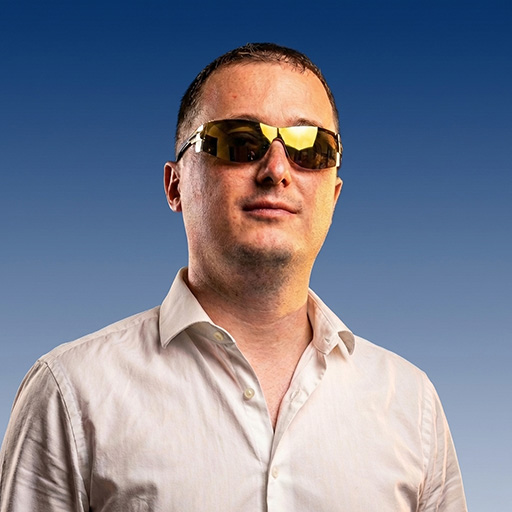
Founder and CTO Pharos Production
I design and build reliable software solutions - from lightweight apps to high-load distributed systems and blockchain platforms.
PhD in Artificial Intelligence, MSc in Computer Science (with honors), MSc in Electronics & Precision Mechanics.
13 years in architecture of great software solutions tailored to customer needs for startups and enterprises
23 years of practical enterprise customized software production experience
Lecturer at the National Kyiv Polytechnic University
Doctor of Philosophy in Artificial Intelligence
Master's degree in Computer Science, completed with excellence
Master's degree in Electronics and precision mechanics engineering
Pharos Production scopes engagements in three tiers, Proof of concept, MVP build and Enterprise platform, with typical budgets from $10,000 to $500,000+ depending on scope and complexity.
Focused validation of your riskiest technical assumption with a working spike, a clean codebase and a clear build-or-pivot recommendation.
Production-ready first version with core user flows, real backend, authentication and the integrations you need to onboard first paying users.
Full-scale build covering architecture, DevOps, QA, security and long-term evolution across teams and regions.
Prices vary based on project scope, complexity, timeline and requirements. Hourly rates range from $50 to $99 depending on role and seniority. Contact us for a personalized estimate.
Need extra hands on your software project? Our developers can jump in at any stage - from architecture to auditing - and integrate seamlessly with your team to fill any technical gaps.
Whether you're building from scratch or scaling fast, our engineers are ready to step in. You stay in control, and we handle the code.
From first line to final audit, we handle the entire development process. We will deliver secure, production-ready software, while you can focus on your business.
Our engineers work with 45+ ai technologies - chosen for production reliability and performance.
Recognized on Clutch, GoodFirms and The Manifest for software engineering excellence








65+ industry awards
Our company starts and assembles an entire project specialists with the perfect blend of skills and experience to start the work.
We'll design, build and launch your MVP, ensuring it meets the core requirements of your software solution.
We'll create a complete software solution that is custom-made to meet your exact specifications.
Our company will be right there with you, keeping your software solution running smoothly, fixing issues and rolling out updates.
RPA vs AI automation comparison for 2026. Decision framework with cost analysis, comparison table, hybrid approach and real-world use cases for each technology.
AI automation in 2026 has moved far beyond chatbots and simple workflow triggers. Enterprises are deploying autonomous AI agents that plan, reason and execute multi-step business processes with minimal human oversight. This article covers the most consequential AI automation trends shaping enterprise operations - from agentic process automation and AI-native software development to autonomous supply […]

Practical guide to implementing machine learning for business in 2026. Covers ML use cases across industries, ROI frameworks, implementation steps, cost analysis and common pitfalls with specific numbers and benchmarks.

Insurance claims are where carriers win or lose customers. A claim that takes three weeks and five phone calls drives churn; one that settles in a day builds loyalty. Claims automation software is how modern insurers and InsurTechs close that gap - by digitizing first notice of loss, triaging severity, reading documents and paying straight-through […]
Type to filter questions and answers. Use Topic to narrow the list.
Showing all 10
No matches
Try a different keyword, change the topic or clear filters
RPA is best suited for high-volume, rule-based processes with stable UI or API interfaces: invoice processing, data entry between legacy systems, report generation, order-status lookups and compliance data collection. Processes with more than 500 monthly manual transactions and fewer than three decision branches per workflow typically deliver the strongest ROI.
We develop bots on UiPath, Automation Anywhere (A360), Power Automate and custom Python frameworks using libraries such as Playwright, pyautogui and pywin32. Platform selection depends on your IT stack, licensing budget and whether the process requires unattended server execution or attended desktop assistance.
A single-process bot covering a linear workflow with two to three screen interactions typically goes from process discovery to production in four to six weeks. More complex bots with conditional branching, exception handling and integrations with two or more back-end APIs take eight to twelve weeks and require a formal process definition document before development begins.
Intelligent Process Automation (IPA) adds AI components - OCR for unstructured documents, NLP for email classification and ML models for exception scoring - on top of a standard RPA bot. Where a standard bot can only handle structured inputs, an IPA workflow can read a scanned invoice, extract line items and route exceptions flagged by a confidence score below a set threshold.
Every bot includes a global exception handler that logs the failed transaction with a screenshot and context payload to a central orchestrator dashboard, retries transient errors up to three times with exponential back-off and routes persistent failures to a human review queue. Alerting is wired to PagerDuty or Slack so on-call teams see failures within minutes.
Bot credentials are stored in the platform's encrypted credential vault (UiPath Orchestrator assets or Automation Anywhere Credential Manager) and never hardcoded in workflow files. Bots run under dedicated service accounts with least-privilege permissions. All bot activity is audit-logged at the action level, exportable to your SIEM for compliance review.
Yes. We use UI automation (element anchoring, image recognition and OCR fallback) for legacy Windows desktop applications that expose no API or database connection.
We apply resiliency patterns - dynamic selector generation and visual baseline assertions - so bots survive minor UI changes such as button repositions or column reorders without breaking.
RPA is right when the workflow is stable, rule-based and crosses systems with no API. If any of those is missing, RPA usually creates more maintenance than it saves.
The first question we ask is whether an API exists, because direct integration is almost always more reliable when it does.
Single bots from $9,500; bot programs $35,000-$120,000; ongoing maintenance about $1,500 per bot per month. Maintenance is not optional and we are upfront about it during scoping.
We decline when the system has a documented API, when the underlying process is broken and should be redesigned first, when there is no named bot owner on the client side or when the client has no capacity to monitor bot health after launch.
RPA is not a bot-factory exercise. It is a control-plane engineering problem where the valuable outputs are audit trails, rollback pathways and measurable hours returned, not green check-marks on a dashboard[1]. Pharos runs RPA programs with the same delivery discipline as production backend services so the bots keep earning their keep past the first quarter.
Achieve them with minimized risk through our bespoke innovation capabilities
Contact us today to discuss your project. We're ready to review your request promptly and guide you on the best next steps for collaboration
Same dayWe're committed to keeping your information confidential, so we'll sign a Non-Disclosure Agreement
1 dayAfter we chat about your goals and needs, we'll craft a comprehensive proposal detailing the project scope, team, timeline and budget
3-5 daysLet's connect on Google Meet to go through the proposal and confirm all the details together!
1-2 daysAs soon as the contract is signed, our dedicated team will jump into action on your project!
Same dayHeadquarters in Las Vegas, Nevada. Engineering office in Kyiv, Ukraine.
We also work with clients through dedicated local teams in Las Vegas, New York and San Francisco.
Thanks for the request!
We typically reply within 24 hours