
Energy Software Development in 2026: Types, Cost and Build Guide
Energy software development in 2026: smart grid, energy management, trading and field-service types, build vs buy, costs and timelines by scope.

Energy software development is the process of building digital platforms for utilities, renewable energy operators and energy traders - from grid management systems and DERMS (Distributed Energy Resource Management Systems) to EV charging networks and carbon accounting platforms.
Pharos Production is an energy software development company that builds smart grid platforms, DERMS systems, EV charging management software and renewable energy monitoring solutions for utilities, energy providers, EV charging operators and microgrid developers. The energy management software market was projected to reach $60.94 billion in 2026, with the EV charging management software market projected to reach $36 billion by 2035. Founded in 2013 with 90+ engineers, Pharos Production delivers IEC 62443-compliant energy platforms with IoT sensor integration. Every project follows our Verified Delivery process.

Practice led by Dmytro Nasyrov
Founder and CTO
23+ years in software development. Led IoT and data-intensive energy platforms for utilities and renewable energy providers, ISO 27001-aligned.
Energy software development in 2026: smart grid, energy management, trading and field-service types, build vs buy, costs and timelines by scope.

IoT development guide covering architecture patterns, MQTT and communication protocols, AWS/Azure platforms, security best practices and cost planning.

Practical guide to implementing machine learning for business in 2026. Covers ML use cases across industries, ROI frameworks, implementation steps, cost analysis and common pitfalls with specific numbers and benchmarks.
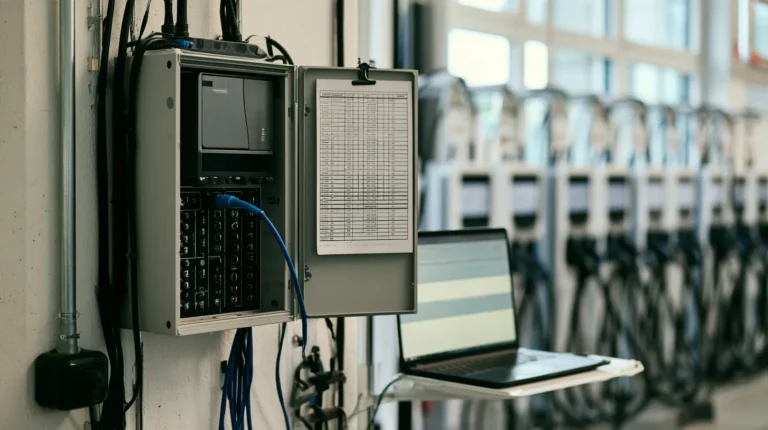
The two parts of an OpenADR integration that sit outside the certified VTN to VEN interface: how each OpenADR 3 event interval becomes an OCPP 2.0.1 SetChargingProfile, with a capacity ceiling and a per-transaction schedule stacked on one station, and what the platform does when the VTN stops answering. Around them, the VTN and VEN roles, registration and OAuth, reporting, 2.0b coexistence and certification as a process.

LDAR software for an EU oil or gas operator is the system of record behind the leak detection and repair program that Regulation (EU) 2024/1787 requires. This guide sets out the component, survey, leak, repair, delay and flare records the Regulation implies, the 5-day and 30-day repair clocks and how versioned rule tables absorb implementing acts still to come.
Pharos Production applies its full-cycle software development expertise to deliver tailored solutions for energy and utilities businesses.
A digital platform that monitors, controls and optimizes power distribution networks. It improves grid reliability by detecting outages early and balancing energy loads in real-time.
A system that gathers energy usage data from meters, sensors and connected devices. This system helps businesses cut costs by identifying inefficiencies and predicting energy demand.
A fully automated metering, invoicing and payment processing system for utility providers ensures accurate billing, reduces service errors and improves customer satisfaction.
A solution that monitors the health and performance of critical infrastructure, such as transformers, pipelines and turbines. It uses predictive analytics to prevent failures and extend equipment lifespan.
A system that monitors solar, wind and hybrid renewable assets in real-time, providing performance analytics. It optimizes energy production and enhances the long-term efficiency of assets.
A platform that rapidly detects outages and automatically sends field teams based on priority and location. This speeds up recovery times and enhances service reliability for customers.
A secure platform for trading electricity, gas and renewable energy credits in both wholesale and retail markets. It streamlines bidding, forecasting and settlement processes for energy providers.
A system that automates meter reading and supplies real-time consumption data to utilities and customers. It supports dynamic pricing models and lowers operational costs.
Software that optimizes energy use during peak hours through automated controls or customer incentives. This method helps utilities reduce grid stress and boost overall energy stability.
A digital solution for tracking emissions across operations, equipment and supply chains. It supports sustainability reporting and helps organizations meet regulatory and ESG standards.
| Solution | Key capabilities |
|---|---|
| Smart Grid Management Systems | Real-Time Grid Monitoring and Load Balancing Platform Automated Fault Detection and Outage Isolation System Distributed Energy Resource (DER) Integration Module +4 |
| Energy Consumption Monitoring & Analytics Platforms | Real-Time Energy Usage Tracking and Visualization Dashboard Smart Meter Data Collection and Aggregation System AI-Based Energy Efficiency and Cost Optimization Engine +4 |
| Utility Billing & Customer Management Systems | Automated Meter Reading and Billing Calculation Engine Customer Account and Service Profile Management Portal Multi-Method Payment Processing and Auto-Debit Module +4 |
| IoT-Based Asset Monitoring & Predictive Maintenance | Real-Time Equipment Health and Performance Monitoring IoT Sensor Integration for Vibration, Temperature and Pressure Data Predictive Failure Analysis and Machine Learning Models +4 |
| Renewable Energy Management Platforms | Solar and Wind Asset Performance Monitoring Dashboard Real-Time Energy Production and Yield Optimization Engine Inverter, Turbine and Sensor Data Integration Module +4 |
| Outage Detection & Field Service Management | Real-Time Outage Detection and Fault Location Engine Automated Crew Dispatch and Route Optimization System Field Technician Mobile Work Order App +4 |
| Energy Trading & Market Integration Platforms | Real-Time Market Price Monitoring and Trading Dashboard Automated Bidding and Auction Participation Engine Risk Management and Hedging Strategy Module +4 |
| Smart Metering & AMI (Advanced Metering Infrastructure) | Smart Meter Deployment and Remote Configuration System Advanced Meter Data Collection and Validation Engine Two-Way Communication Network for Meter Connectivity +4 |
| Demand Response Management Systems | Automated Load Control and Demand-Side Response Engine Consumer Participation and Incentive Management Platform Real-Time Grid Stress Monitoring and Event Trigger System +4 |
| Carbon Footprint Tracking & Sustainability Platforms | Automated Carbon Emissions Data Collection and Calculation Engine Enterprise Sustainability Metrics and ESG Reporting Dashboard Energy Consumption and Waste Reduction Analytics Tool +4 |
Energy software market in numbersThe energy management software market was projected to reach $60.94 billion in 2026 (MarketsandMarkets). The EV charging management software market is projected to reach $36 billion by 2035 at 31.3% CAGR (Allied Market Research). AI in renewable energy was projected to be valued at $26.30 billion in 2026 (Grand View Research). Cyberattacks on US utilities increased 70% YoY in 2024 (North American Electric Reliability Corporation).
Pharos Production energy delivery metricsAverage time to MVP for energy management platforms is 12 weeks. Production infrastructure uptime averages 99.9% under SLA. IoT sensor data pipelines tested with real hardware before deployment. The Verified Delivery process uses 2-week sprints with IEC 62443 security validation at every iteration.
| Factor | Custom Energy Software | Off-the-Shelf (Siemens EnergyIP, GE) |
|---|---|---|
| DER integration | Any device, any protocol via custom adapters | Limited to vendor-supported equipment |
| Grid analytics | Custom AI models for your grid topology | Pre-built analytics, limited customization |
| EV charging | Multi-vendor OCPP, custom billing logic | Vendor-locked charging networks |
| Carbon reporting | Custom Scope 1-2-3, any framework | Standardized templates, limited flexibility |
| Scalability | 10K-100K+ DERs, real-time processing | Tier-based licensing, scaling limits |
| Cost model | One-time development + hosting | Per-device/per-site licensing fees |
Pharos Production recommends custom energy software for utilities managing 1,000+ distributed assets, renewable operators with proprietary forecasting needs or energy traders requiring real-time analytics.
Smart Grid Management Systems
Real-time platforms optimize electricity distribution, balance demand and reduce outages through automated grid control.
IoT-Based Energy Monitoring Networks
Connected sensors track energy consumption, equipment performance and environmental conditions across extensive utility infrastructures.
Energy Trading and Optimization Platforms
Advanced analytics support bidding, forecasting and hedging strategies for both wholesale and retail energy markets.
Asset Performance Management (APM) Software
Predictive models monitor turbines, transformers and pipelines to prevent failures and extend asset lifespans.
Demand Response Automation Systems
Artificial intelligence dynamically adjusts energy loads and incentivizes consumers to shift their usage during peak-demand periods.
Renewable Energy Management Platforms
Tools monitor solar, wind and battery storage assets to maximize energy yield and ensure grid stability.
Digital Twin Technology for Utility Infrastructure
Virtual replicas of plants, grids and pipelines help engineers test scenarios and plan maintenance without causing disruptions.
Field Service Management Solutions
Mobile and cloud-based tools coordinate technicians, optimize routing and ensure a rapid response to utility issues.
When a regional utility needed to orchestrate 15,000 distributed energy resources (rooftop solar, battery storage, EV chargers) across a 50,000-customer service territory, the core challenge was real-time coordination - each DER has its own production/consumption pattern and the grid requires second-by-second balancing. Our approach: an event-driven architecture where each DER publishes telemetry via MQTT to an Apache Kafka stream. A forecasting engine (LSTM neural network trained on 3 years of weather + generation data) predicts solar output and load patterns 24 hours ahead. The dispatch optimizer uses linear programming to determine optimal battery charge/discharge and EV charging schedules every 5 minutes, minimizing grid stress while maximizing renewable self-consumption. We implemented IEEE 2030.5 for DER communication and OpenADR for demand response signaling. The platform reduced peak grid demand by 18% and increased renewable utilization from 62% to 78%. Explore our open-source libraries on GitHub.
| Metric | Before Pharos | After Pharos |
|---|---|---|
| DER visibility | Manual meter reads, monthly data | Real-time telemetry from 15K assets |
| Peak demand management | Reactive curtailment only | 18% peak reduction via predictive dispatch |
| Renewable utilization | 62% of solar/wind captured | 78% with optimized battery scheduling |
| Forecasting accuracy | Day-ahead, 70% accuracy | 4-hour ahead, 92% accuracy (LSTM model) |
| Demand response | Manual phone-based curtailment | Automated OpenADR signaling, 5-min response |
| Grid incidents | 12 overload events per year | 2 events per year with predictive balancing |
Metrics from a regional utility DERMS deployment (15,000 DERs across 50,000 customers). Renewable utilization measured over 12 months of production operation.
Independent reviews from Clutch, GoodFirms and direct client testimonials - verified feedback on our software projects
Based on 342 verified reviews
Proprietary research report based on analysis of energy management projects delivered by Pharos Production. Dataset covers SCADA, smart grid and meter data systems. Methodology (Pharos Verified Delivery): aggregated delivery metrics with 6-18 months post-deployment monitoring per project. IEC 62443 security validation. Full report with detailed methodology available on request.
Key technology shifts that impact how Pharos Production architects energy and utilities software for clients.
AI-Powered Grid Intelligence
AI improves solar forecasting by 13% and wind by 50%. AI-based maintenance reduces turbine costs by 25%. Pharos Production builds AI forecasting platforms with weather integration, generation analysis and real-time grid balancing.
DERMS and Distributed Energy Resources
DERMS platforms manage 10,000-100,000 DERs (solar, batteries, EVs). Smart meter penetration at 52% heading to 75% by 2028. Pharos Production builds DERMS platforms with real-time orchestration, automated dispatch and SCADA integration.
EV Charging Network Management
The EV charging management software market is projected to reach $36 billion by 2035 (Allied Market Research). Pharos Production builds OCPP-compliant station management with energy load balancing, billing, fleet scheduling and demand response integration.
Carbon Management and ESG Reporting
The carbon management software market reaches $31.5 billion by 2031 (MarketsandMarkets). Pharos Production builds carbon accounting platforms with Scope 1-2-3 tracking, carbon credit marketplace integration and EU CSRD-compliant reporting.
Digital Twins for Energy Assets
Digital twin adoption in energy grows at 22% CAGR. Battery optimization improves lifetime profit by 25-29%. Pharos Production builds energy digital twins with real-time IoT integration, predictive maintenance and scenario simulation.
Microgrid Controller Software
Microgrids combine solar, storage and generators for resilient local power. Pharos Production builds microgrid controller software with islanding detection, DER dispatch, battery arbitrage optimization and grid reconnection management.
Pharos Production scopes engagements in three tiers, Proof of concept, MVP build and Enterprise platform, with typical budgets from $10,000 to $500,000+ depending on scope and complexity.
Focused validation of your riskiest technical assumption with a working spike and a clear build-or-pivot recommendation.
Production-ready first version with core flows, real backend and the integrations to onboard first paying users.
Full-scale build with architecture, DevOps, QA, security and long-term evolution.
Prices vary based on project scope, complexity, timeline and requirements. Hourly rates range from $50 to $99 depending on role and seniority. Contact us for a personalized estimate.
Need extra hands on your software project? Our developers can jump in at any stage - from architecture to auditing - and integrate seamlessly with your team to fill any technical gaps.
Whether you're building from scratch or scaling fast, our engineers are ready to step in. You stay in control, and we handle the code.
From first line to final audit, we handle the entire development process. We will deliver secure, production-ready software, while you can focus on your business.
| Model | Best for | Team setup | Budget range |
|---|---|---|---|
| Staff Augmentation | Existing teams needing extra engineers at any project stage | 1-2 weeks | From $5,000/month |
| Dedicated Team Popular | Long-term projects requiring full ownership and control | 2-4 weeks | From $15,000/month |
| Project Outsourcing | Full-cycle development from idea to production launch | 1-2 weeks | $10,000-$80,000+ |
Our company starts and assembles an entire project specialists with the perfect blend of skills and experience to start the work.
We'll design, build and launch your MVP, ensuring it meets the core requirements of your software solution.
We'll create a complete software solution that is custom-made to meet your exact specifications.
Our company will be right there with you, keeping your software solution running smoothly, fixing issues and rolling out updates.
Our engineers work with 187+ technologies across blockchain, backend, frontend, mobile and DevOps - chosen for production reliability and performance.
Our engineers work with 187+ technologies across 10 categories: Frameworks, AI, Blockchains, DevOps, Clouds, Databases, Brokers, Tests, Programming, UI/UX.


































































Recognized on Clutch, GoodFirms and The Manifest for software engineering excellence










65+ industry awards
Answers to common questions about energy and utility software development.
Type to filter questions and answers. Use Topic to narrow the list.
Showing all 12
No matches
Try a different keyword, change the topic or clear filters
Pharos Production builds custom energy management systems with real-time grid monitoring dashboards, load forecasting and automated demand response. Our platforms integrate with SCADA, DCS and back-end infrastructure for utility-grade reliability. Related: Agriculture and Construction solutions.
Pharos Production integrates energy platforms with SCADA, OPC-UA, Modbus and industrial IoT protocols. The team builds secure data bridges between operational technology (OT) and IT systems with real-time telemetry processing.
Pharos Production builds high-throughput data pipelines that process millions of smart meter readings per hour using event-driven architecture on cloud infrastructure with auto-scaling and time-series databases.
Energy project costs depend on integration complexity and data volume. A smart metering dashboard MVP may start from $40,000-$80,000, while a full grid management platform can range from $150,000 to $500,000+. Request a free estimate.
Pharos Production builds monitoring and optimization platforms for solar, wind and battery storage installations. Our solutions include production forecasting, maintenance scheduling and grid interconnection management.
An energy monitoring dashboard MVP typically takes 3-5 months. A full grid management system with SCADA integration may require 6-12 months. Pharos Production uses agile methodology with 2-week sprints.
We do not install hardware, deploy IoT sensors or provide energy consulting services. Our focus is the software layer - grid management dashboards, SCADA integration, smart metering platforms and renewable energy monitoring. For hardware installation, we recommend partnering with specialized OT vendors.
Energy systems require 24/7 uptime and zero-downtime deployments. Our 2-week sprints include canary deployments and rollback testing at every iteration, ensuring no disruption to grid operations.
DERMS (Distributed Energy Resource Management System) monitors, controls and coordinates distributed energy resources - rooftop solar, battery storage, EVs and smart thermostats - on the electrical grid. DERMS deployment costs $5-20 million and can manage 10,000-100,000 DERs. Pharos Production builds DERMS platforms with real-time grid orchestration, automated dispatch and integration with utility SCADA systems.
Yes. The EV charging management software market is projected to reach $36 billion by 2035 at 31.3% CAGR. Pharos Production builds OCPP-compliant charging station management platforms with energy load balancing, billing and payment processing, fleet scheduling, real-time station monitoring and integration with grid operators for demand response.
AI improves solar energy forecasting accuracy by 13% and wind forecasting by 50% compared to traditional methods. AI-based predictive maintenance reduces wind turbine operating costs by up to 25%.
Pharos Production builds AI forecasting platforms with weather data integration, historical generation analysis and real-time grid balancing algorithms.
Cyberattacks on US utilities increased 70% YoY in 2024. Smart grid software must comply with IEC 62443, NIST CSF and NERC CIP frameworks. Key requirements: OT/IT network segmentation, zero-trust architecture, encrypted protocols (TLS for MQTT/OPC UA), intrusion detection and incident response planning. Pharos Production builds IEC 62443-compliant energy platforms with defense-in-depth security architecture.

90+ engineers ready to deliver your Energy and Utilities project on time and within budget
Contact us today to discuss your project. We're ready to review your request promptly and guide you on the best next steps for collaboration
Same dayWe're committed to keeping your information confidential, so we'll sign a Non-Disclosure Agreement
1 dayAfter we chat about your goals and needs, we'll craft a comprehensive proposal detailing the project scope, team, timeline and budget
3-5 daysLet's connect on Google Meet to go through the proposal and confirm all the details together!
1-2 daysAs soon as the contract is signed, our dedicated team will jump into action on your project!
Same dayHeadquarters in Las Vegas, Nevada. Engineering office in Kyiv, Ukraine.
We also work with clients through dedicated local teams in Las Vegas, New York and San Francisco.
Thanks for the request!
We typically reply within 24 hours