
Founder & engineering leadership
Dmytro Nasyrov
Founder and CTO Pharos Production
Founder of Pharos Production, PhD in Artificial Intelligence and lecturer at Igor Sikorsky Kyiv Polytechnic Institute.

About
Dmytro Nasyrov is the founder and CTO of Pharos Production, a software development and AI engineering company since 2013. With 23 years of engineering experience and a PhD in Artificial Intelligence, he leads engineering culture at Pharos and lectures at Igor Sikorsky Kyiv Polytechnic Institute.
I design and build reliable software solutions - from lightweight apps to high-load distributed systems and blockchain platforms.
PhD in Artificial Intelligence, MSc in Computer Science (with honors), MSc in Electronics & Precision Mechanics.
Education and credentials
- PhD in Artificial Intelligence
- Lecturer, Igor Sikorsky Kyiv Polytechnic Institute
- Alumnus, Igor Sikorsky Kyiv Polytechnic Institute
Areas of expertise
- Artificial Intelligence - LLM integration, RAG, agents, ML platforms
- Blockchain protocols - DeFi, NFT, smart contracts, dApps
- FinTech platforms - payments, compliance, RegTech
- Custom software development - web, mobile, enterprise
- DevOps and cloud architecture
- Engineering leadership - strategy, technical due diligence
Career timeline
-
Founder and CTO, Pharos Production
Software development and AI engineering. 90+ engineers, 110+ apps for 200+ clients across 28 industries. Aligned with ISO 27001, SOC 2, HIPAA, PCI DSS and GDPR frameworks.
-
Lecturer, Igor Sikorsky Kyiv Polytechnic Institute
Teaching engineering at Ukraine's leading technical university.
Ideas from practice
Articles by Dmytro Nasyrov

Carrier Integration Layer
A build guide for the layer between a logistics platform and its carriers: one canonical shipment event model, a status mapping table that places generic parcel API statuses, LTL EDI 214 status messages and DCSA Track and Trace events side by side, per-carrier adapters, push delivery with a reconciliation poll, idempotent handling of duplicate and out-of-order events and detection of shipments that stop reporting.

Payment Reconciliation Engine
A payment reconciliation engine proves that every movement in a platform's ledger also happened at the bank and, where a PSP carried it, at the PSP. The design below normalizes all three legs into one event model, matches on references before tolerances, posts fees and chargebacks separately and turns every unexplained difference into a typed break with an owner.

Smart Contract Development Cost: How to Budget a Production Project
Build a smart contract estimate around accepted deliverables. A hypothetical escrow budget shows engineering effort, an upgrade option and the external costs that still need quotes before launch.
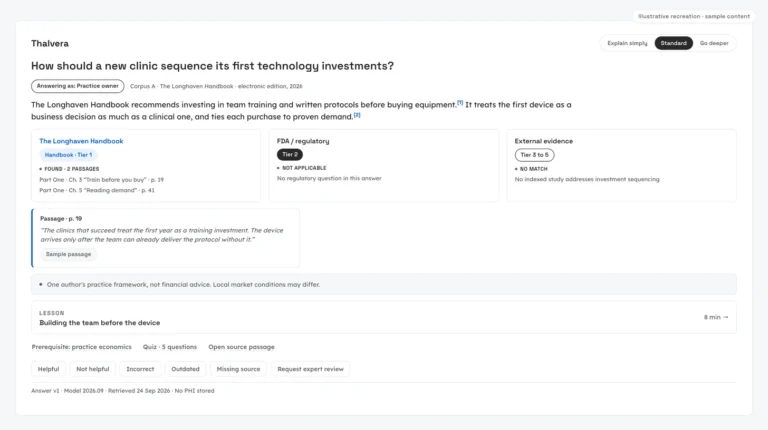
AI Citation UX for Aesthetic Medicine: Our Mockups Hallucinated Before the Model Did
Before any model wrote an answer, our own mockups had invented citations. We redesigned an aesthetic-medicine learning platform so that every claim cites a printed page and every gap in its knowledge becomes a designed screen.

dApp Wallet Connection
EIP-6963 does not replace window.ethereum, it adds a race-free discovery channel next to it. This guide works through what a dApp actually has to do at each layer of a wallet connection: EIP-1193's provider interface and its five events, a WalletConnect Sign v2.0 session whose granted namespace can differ from what was requested, a SIWE sign-in bound to an address and a domain, ERC-1271 and ERC-6492 signature verification for smart and counterfactual accounts, capability detection before a batched call and what EIP-7702 delegation means for a signature check written to assume every connected address is a plain externally owned account.

Insurance Rating Engine
This guide treats a rate manual as a layered composite rather than a single document, drawing on the NAIC's own Product Filing Review Handbook, and works through the seven components a rating engine needs to make that composite queryable at run time, from effective-dated rate tables and factors keyed on the current term's effective date through the parity and regression testing that catches drift from the filed manual before a regulator or an audit does.
Last updated: