
Skip to content

Engineering

  • A translucent AI agent figurine standing on a five-step podium of increasing height, representing tiered AI agent development cost.
    AI Agent Development Cost: Complete Breakdown 2026

    AI agent development costs range from $10,000 for a simple chatbot to $300,000+ for enterprise multi-agent systems. The final cost depends on agent complexity, number of integrations, model selection, security requirements and deployment infrastructure. Based on 110+ projects delivered since 2013, Pharos Production provides transparent cost estimates within 48 hours of receiving requirements. This guide […]

  • A minimalist enterprise building balanced on a narrow fulcrum with a pilot prototype on one side and a scaled production system on the other.
    Enterprise AI Adoption Guide 2026: From Strategy to Production

    Enterprise AI adoption in 2026 is at a tipping point. 78% of enterprises report using AI in at least one business function, but only 22% have successfully scaled AI beyond pilot projects, according to the McKinsey Global AI Survey (2024). The gap between experimentation and production deployment is where most AI initiatives fail – not […]

  • A brass balance scale with a translucent brain sphere on one pan and a stack of rulebooks on the other, symbolising responsible AI governance.
    AI Governance Framework: Building Responsible AI Systems

    AI governance is no longer optional. The EU AI Act enforcement began in 2025, with full compliance requirements taking effect across 2026. Organizations deploying AI systems in production face mandatory risk assessments, bias testing, transparency requirements and incident reporting obligations. This guide provides a practical framework for building responsible AI systems that meet regulatory requirements […]

  • Minimalist sculptor hands refining a translucent LLM sphere on a workbench with geometric chisels, representing LLM fine-tuning.
    LLM Fine-Tuning Guide: LoRA, RLHF and DPO Explained

    Fine-tuning large language models transforms general-purpose AI into domain-expert systems that understand your industry terminology, follow your output format requirements and achieve accuracy levels that prompting alone cannot reach. This guide covers the three dominant fine-tuning techniques in 2026 – LoRA, RLHF and DPO – with practical guidance on when to use each, how to […]

  • Autonomous drones gliding along a transparent conveyor with long-exposure light trails, representing autonomous AI automation trends.
    AI Automation Trends 2026: What Businesses Need to Know

    AI automation in 2026 has moved far beyond chatbots and simple workflow triggers. Enterprises are deploying autonomous AI agents that plan, reason and execute multi-step business processes with minimal human oversight. This article covers the most consequential AI automation trends shaping enterprise operations – from agentic process automation and AI-native software development to autonomous supply […]

  • A swarm of translucent geometric drones flying in formation with light trails, illustrating a collaborative multi-agent AI system.
    Multi-Agent Systems: Complete Guide for Enterprise 2026

    Multi-agent systems represent a fundamental shift in how enterprises build AI. Instead of relying on a single monolithic model to handle every task, multi-agent architectures deploy specialized AI agents that collaborate, delegate and coordinate to solve complex business problems. This guide covers the architecture patterns, frameworks, coordination strategies and production deployment lessons that engineering teams […]

  • Floating translucent documents in a grid with one sliding toward a glowing query node on a blue light beam, illustrating RAG retrieval.
    RAG vs Fine-Tuning: When to Use Each for AI Projects

    Quick Comparison: RAG vs Fine-Tuning Factor RAG Fine-Tuning Best for Dynamic knowledge bases, 10K+ documents Narrow domain tasks, consistent behavior Update speed Instant (add/remove docs) Requires retraining (hours to days) Upfront cost $5K-$20K (vector DB + pipeline) $500-$5,000 per training run Per-query cost Higher (retrieval + inference) Lower (single model call) Accuracy Broad coverage, may […]

  • A 3D landscape of translucent glass bars rising from left to right with a soft ROI curve arcing above them, symbolising ML business returns.
    Machine Learning for Business: A Practical Guide for 2026

    Practical guide to implementing machine learning for business in 2026. Covers ML use cases across industries, ROI frameworks, implementation steps, cost analysis and common pitfalls with specific numbers and benchmarks.

  • Macro close-up of a translucent camera lens element with a blue iris and faint detection grid reflections, symbolising computer vision across industries.
    Computer Vision Use Cases Across Industries in 2026

    Computer vision use cases across manufacturing, healthcare, retail and security in 2026. Real implementation details, cost benchmarks and ROI data for CV deployments.

  • A river of glyphs and punctuation flowing from left and crystallizing into translucent data blocks on the right, symbolising enterprise NLP.
    NLP for Enterprise: Natural Language Processing Applications

    Enterprise NLP applications guide covering contract analysis, sentiment analysis, chatbots and document processing. Implementation strategies, cost benchmarks and ROI data for 2026.

  • Split scene with mechanical gears on the left and a translucent glowing brain on the right, comparing RPA and AI automation.
    RPA vs AI Automation: When to Use Each in 2026

    RPA vs AI automation comparison for 2026. Decision framework with cost analysis, comparison table, hybrid approach and real-world use cases for each technology.

  • A human figure at a clean desk with a faint translucent copilot silhouette overlapping their shoulder, representing enterprise AI copilots.
    Building AI Copilots for Enterprise: A Complete Guide

    Complete guide to building enterprise AI copilots. Covers architecture, RAG implementation, guardrails, deployment patterns and cost planning with specific benchmarks.

  • A server tower cluster on the left and a translucent cloud on the right connected by a frozen arc of luminous data packets, symbolising cloud migration.
    Cloud Migration Strategy: Step-by-Step Guide for 2026

    Cloud migration strategy guide for 2026. Step-by-step assessment, planning and execution with AWS vs Azure vs GCP comparison, cost benchmarks and optimization tips.

  • A solid translucent monolith block on the left captured mid-shatter into interconnected floating cubes on the right, illustrating microservices decomposition.
    Microservices vs Monolith: Architecture Decision Guide

    Microservices vs monolith architecture decision guide. Comparison table, modular monolith pattern, migration strategies and cost analysis for development teams.

  • A vintage mainframe on the left dissolving into modern translucent cloud-native blocks on the right, symbolising legacy system modernization.
    Legacy System Modernization: Strategies and Best Practices

    Legacy system modernization guide. Strangler fig pattern, replatforming, rebuild strategies with cost comparison table, budget planning and implementation best practices.

  • Two minimalist phone silhouettes emitting contrasting teal and cyan ripples, comparing Flutter and React Native cross-platform mobile frameworks.
    Flutter vs React Native: Complete Comparison for 2026

    Flutter vs React Native comparison for 2026. Performance benchmarks, developer experience, ecosystem maturity, cost analysis and decision framework for mobile development.

  • A translucent credit card with circuit traces transforming into AI neural branches, representing AI transforming financial services.
    AI in FinTech: Transforming Financial Services in 2026

    AI in FinTech applications for 2026. Fraud detection, credit scoring, robo-advisors and compliance automation with implementation costs and regulatory guidance.

  • Geometric IoT devices scattered on a white surface connected by faint light arcs forming a constellation, symbolising a connected IoT ecosystem.
    IoT Development Guide: Architecture, Protocols and Platforms

    IoT development guide covering architecture patterns, MQTT and communication protocols, AWS/Azure platforms, security best practices and cost planning.

  • A small startup building protected by three translucent concentric shield domes, symbolising layered cybersecurity defense.
    Cybersecurity Essentials for Startups and SMBs in 2026

    Cybersecurity guide for startups and SMBs in 2026. Top 10 security measures, compliance basics (SOC 2, GDPR, HIPAA), budget guide and cost-effective tools.

  • Isometric exploded view of five translucent glass layers representing infrastructure, protocol, smart contract, dApp and interface tiers of a Web3 stack.
    Guide to the Web3 Stack for Developers in 2026

    This guide breaks down the Web3 development stack in 2026 and explains how modern teams choose blockchain tools that hold up in production. You will learn how wallets, smart contracts, nodes, indexing, storage and observability fit together and what tradeoffs developers should consider for security, performance and cost. Use it as a practical reference for planning architecture and shipping reliable Web3 applications.

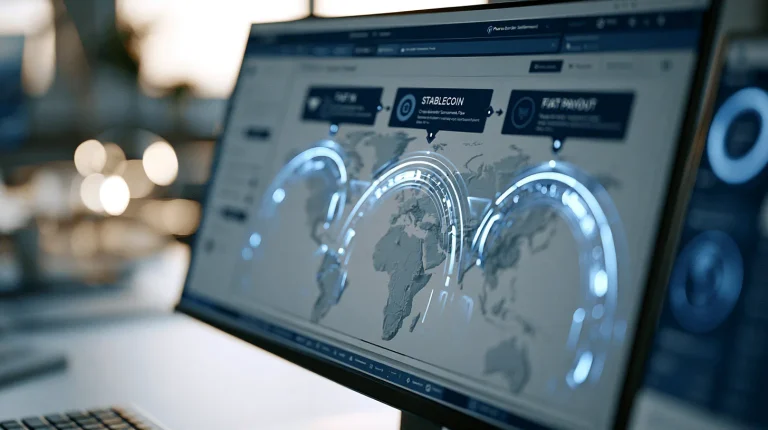
  • A translucent coin suspended by a taut blue thread anchored to a dollar anchor on a pale surface, visualising the stablecoin peg.
    How Crypto Works. Stablecoins

    Stablecoins are cryptocurrencies whose rate is stabilized by being tied to the value of tangible assets. The most famous example is the USDT token, worth $1. These tokens are convenient for mutual settlements since the value of other cryptocurrencies tends to change unpredictably and significantly over time. In addition to dollars, such tokens can be backed by precious metals, oil, or other cryptocurrencies. Sometimes, they are not supported by anything, but the increase and decrease of the money supply in circulation is controlled by intelligent contract algorithms, which ensures their relatively stable rate.

Dmytro Nasyrov, Founder and CTO at Pharos Production
Dmytro Nasyrov Founder & CTO Let’s work together!

Your business results matter

Achieve them with minimized risk through our bespoke innovation capabilities

Your contact details
Please enter your name
Please enter a valid email address
Please enter your message
* required

We typically reply within 4 hours. Prefer email? [email protected]

What happens next?

  1. Contact us

    Contact us today to discuss your project. We’re ready to review your request promptly and guide you on the best next steps for collaboration

    Same day
  2. NDA

    We’re committed to keeping your information confidential, so we’ll sign a Non-Disclosure Agreement

    1 day
  3. Plan the Goals

    After we chat about your goals and needs, we’ll craft a comprehensive proposal detailing the project scope, team, timeline and budget

    3-5 days
  4. Finalize the Details

    Let’s connect on Google Meet to go through the proposal and confirm all the details together!

    1-2 days
  5. Sign the Contract

    As soon as the contract is signed, our dedicated team will jump into action on your project!

    Same day