Aircraft Maintenance Records
EASA sets no single retention period for aircraft maintenance records. This guide maps each record class under Part-M, Part-145 and Part-CAMO to its rule, its holder and its clock, then turns the rules into build requirements for a records system: append-only corrections, CRS records bound to an identifiable signatory, per-record retention and exports that carry every clock through a change of operator or CAMO.
 22 min read
49 views
22 min read
49 views

- Retention depends on the record class and the holder EASA sets different periods for the operator, the Part-145 organization and the CAMO, from 12 months to 5 years, and some classes carry no period, so retention is computed per record from events.
- A correction must leave the original entry visible M.A.305(g) requires every correction to leave the original entry clearly visible, which makes an append-only, versioned record design the most direct way to meet the rule.
- The CRS binds to an identifiable signatory, not to airworthiness EASA's guidance asks for the approval number and the identity of the person who issued the release, and keeps the airworthiness decision with the party managing continuing airworthiness.
- Retention clocks survive a transfer On a permanent transfer the records go with the aircraft and the retention periods continue for the new holder, so imports keep original dates and references.
- The rules reduce to ordinary engineering controls Append-only entries, effective-dated authorizations, event-driven retention, monitored 24-hour backups and a tested per-aircraft export cover the record-keeping points above without any specific product or technology.
In short: EASA rules do not set one retention period for aircraft maintenance records, and the FAA equivalent in 14 CFR 91.417 also separates work records from status records. The period depends on the record class and on who holds it, whether the owner or operator under Part-M, the maintenance organization under Part-145 or the continuing airworthiness management organization (CAMO) under Part-CAMO, and some classes carry no period at all. A records system therefore computes retention per record from events, keeps the original entry visible under every correction, ties each certificate of release to service to an identifiable signatory and exports its clocks intact when the aircraft or its management changes hands. The record-class table maps each class to its rule.
The rule text is Commission Regulation (EU) No 1321/2014 on continuing airworthiness in its consolidated form, where Annex I is Part-M, Annex II is Part-145 and Annex Vc is Part-CAMO. Under its Article 3, Part-M covers the aircraft in the regulation's scope except the lighter other-than-complex motor-powered aircraft listed there, namely airplanes of 2,730 kg maximum takeoff mass or less, helicopters of 1,200 kg or less certified for up to four occupants, other ELA2 aircraft and some non-conventional aircraft. Those follow Part-ML (Annex Vb), with its own record system in ML.A.305, unless they are listed in the air operator certificate of a licensed air carrier. A combined airworthiness organization (CAO) approved under Part-CAO (Annex Vd) serves aircraft that are not complex motor-powered and not listed in such a certificate, and keeps records under CAO.A.090. Neither annex is covered in detail here, and aircraft on the UK register follow UK rules that this guide does not address. Part-CAMO retention wording below is the version amended by Implementing Regulation (EU) 2026/100, whose main provisions apply from 7 August 2026, so retention logic should follow the consolidated text rather than an older compilation. EASA's acceptable means of compliance (AMC) and guidance material (GM) say what an organization should do and leave room for alternatives, so they are guidance, not law. Crew duty records and cargo data exchange have their own guides, on crew rostering software and IATA ONE Record integration.
Aircraft Maintenance Records by Class and Retention Rule
Every row comes from the consolidated regulation, and the last column is the engineering consequence as Pharos Production reads it, not a measured failure rate.
| Record class | Rule reference | Who keeps it | Retention rule | Fields the system must hold | Engineering consequence |
|---|---|---|---|---|---|
| CRS entry in the aircraft continuing airworthiness record system | M.A.305(a) | Owner or operator | Entry within 30 days of completing the maintenance (an entry deadline, not a retention period) | Entry date, accumulated life per parameter, unique CRS reference | The clock starts at work completion, so released work not yet entered needs its own queue ordered by age |
| Aircraft technical log | M.A.305(e)(1), M.A.306(a) | Operator, where M.A.306(a) requires a technical log (CAT, commercial specialized operations, commercial ATO or DTO) | 36 months prior to the last entry | Log entries, outstanding deferred defects that affect operation | The window runs back from the newest entry, so purging keys on the log, not on each page's age |
| AD compliance records and records of scheduled and other maintenance, with their CRSs | M.A.305(e)(2)(i) and (iii) | Owner or operator | Until superseded by equivalent information, but covering not less than 36 months | AD reference, compliance record, CRS reference, detailed work records | Deletion is a condition on supersession and coverage, so a fixed time-to-live is wrong |
| Current modifications and repairs, with their CRSs | M.A.305(e)(2)(ii) | Owner or operator | No period stated; kept while the modification or repair is current | Modification or repair reference, CRS reference, installed state | Retention follows an installed-state flag, and removal is the event that matters |
| In-service history of each life-limited part | M.A.305(d)(1), (e)(3)(i) | Owner or operator | No period stated; the record is the basis of the part's limitation status | Part and serial number, life per limitation parameter, fitted-to history | The history belongs to the part and moves with it between aircraft |
| Aircraft permanently withdrawn from service | M.A.305(e)(4) | Owner or operator | At least 12 months | Entry dates and total in-service life, last effective status and reports, most recent CRSs with detailed records for current modifications, repairs and life-limited part histories | Withdrawal is a state change that opens a new clock over a defined subset |
| Detailed maintenance records, CRSs and associated maintenance data | 145.A.55(a)(3) and (4) | Part-145 organization | 3 years from the CRS; on termination, the last 3 years go to the last customer or owner or are stored as the competent authority specifies | Work cards, CRS, revision status of the data used | The clock runs per CRS, and a closure needs a complete export per customer |
| Personnel records, including certifying staff | 145.A.55(d)(4), CAMO.A.220(c)(3) | Part-145 organization, CAMO | Employment plus 3 years after the person leaves; Part-145 keeps at least 3 years and also counts from withdrawal of an authorization, a CAMO keeps until 3 years | Identity, authorization scope, validity dates | Authorizations are effective-dated, so the system shows what a signatory could sign on the day |
| CAMO work details, airworthiness review and evaluation records | CAMO.A.220(a)(2) to (4) and (6) | CAMO | 3 years after continuing airworthiness management of the aircraft is transferred to another person or organization | Work details, review reports and recommendations, evaluation records | An open-ended hold until management transfers out, then a 3-year clock |
| Permits to fly, and records of an issuing CAMO that does not manage the aircraft | CAMO.A.220(a)(5) and (7) | CAMO | 5 years from issue | Permit, related and supporting documents | A clock from issue beside neighbors on a transfer-triggered clock |
| All retained records when a CAMO ceases operations | CAMO.A.220(a)(8) | CAMO, then the owner | Transferred to the owner of the aircraft | Every retained record with its original dates | A full per-aircraft export the owner can read without the CAMO's software |
One aircraft usually involves all three holders at once. M.A.305(f) makes the party managing continuing airworthiness tasks under M.A.201 responsible for meeting the record-system requirements and presenting the records on request, the Part-145 organization keeps its own copy of what it released and the CAMO retains the M.A.305 records with its own work records. A database serving all three roles has to know which role each record is held under, as the worked example traces.
The Part-M Record System and What It Must Hold
Part-M describes the record system almost as a data model. Under M.A.305(a) of Regulation (EU) No 1321/2014, each certificate of release to service (CRS) "shall be entered in the aircraft continuing airworthiness record system, as soon as practicable and no later than 30 days after the completion of any maintenance." Each entry carries, under M.A.305(b)(1), "the date of the entry, the total in-service life accumulated in the applicable parameter for aircraft, engine(s) and/or propeller(s)". The status records in M.A.305(c) begin with the current mass and balance report and close with "deferred maintenance tasks and deferred defects rectification."
EASA's AMC for Part-M describe how the release reaches that system: the information, "including a unique reference to the certificate of release to service, should be processed in the record system." In a database that reference is a foreign key from the aircraft record to the release, the join every later audit depends on.
The rule that shapes the storage layer most is M.A.305(g) of the regulation: "When it is necessary to correct an entry, the correction shall be made in a manner that clearly shows the original entry." An in-place update that overwrites a recorded entry is therefore ruled out. A correction becomes a new row that points to the entry it corrects and carries its own author and timestamp, while the original stays readable in every view an auditor uses, including exports.
Certificate of Release to Service: Signatory, Identity and Scope
Who issues the CRS, and when, is implementing-rule text. Under 145.A.50(a) of Regulation (EU) No 1321/2014, "A certificate of release to service shall be issued by appropriately authorised certifying staff on behalf of the organisation when that certifying staff has verified that all the maintenance that was ordered has been properly carried out". Under 145.A.50(b), "A certificate of release to service shall be issued before flight at the completion of any maintenance." Neither point uses the word signature or names a technology.
The identity requirement sits in EASA's AMC for Part-145: "Reference should also be made to the EASA Part-145 approval number and the identity of the person who issued the release." That AMC lets the release stay short: "it is acceptable for the certificate of release to service to summarise the maintenance as long as there is a unique cross-reference to the work package containing full details of maintenance carried out."
Two design rules follow. The signing act binds to a named person with a current certification authorization, never to a shared station login. And the CRS points to one fixed version of the work package, so a later edit to the package cannot change what the release appears to cover.
On the electronic form, the AMC to M.A.305(e), which covers the aircraft continuing airworthiness records rather than the release act itself, accepts records held as "original paper document or electronic data (via an approved electronically signed form)". It names no signature standard, and M.A.305(e) asks only for a form acceptable to the competent authority, so the mechanism is the organization's to justify. Whatever it is, the software must show that the signer was who the record says, held the authorization it claims and could not alter the entry afterward without leaving a trace.
A CRS is also narrower than it looks. EASA's GM to 145.A.50(a) says of the release: "In the case of aircraft maintenance, it does not necessarily mean that the aircraft is in airworthy condition." It adds: "Ensuring that the aircraft is airworthy before each flight always remains the responsibility of the person or organisation managing the aircraft continuing airworthiness." A system that marks an aircraft serviceable because a CRS arrived has merged two decisions the rules keep apart.
Part-145 Records and Electronic Work Cards
The maintenance organization's duty is framed by purpose. Under 145.A.55(a)(1) of Regulation (EU) No 1321/2014, "As a minimum, the organisation shall retain all the records that are necessary to prove that all the requirements have been met for the issue of the certificate of release to service". Under 145.A.55(a)(3) it "shall retain a copy of all detailed maintenance records (including certificates of release to service) and of any associated maintenance data for 3 years", counted "from the date when the aircraft or component to which the work relates was issued with a certificate of release to service". Records of management system key processes and contracting and subcontracting contracts are kept for at least 5 years under 145.A.55(c).
Storage is regulated too, in 145.A.55(g) of the regulation: "The records shall be stored in a manner that ensures that they are protected from damage, alteration and theft."
Electronic work cards are permitted in the implementing rule itself. Point 145.A.45(e) of the regulation says "Work cards and worksheets may be computer generated and held in an electronic database that is adequately protected against unauthorised alteration" and requires that "there is a backup electronic database which shall be updated within 24 hours after an entry is made to the main electronic database." For electronic work cards that window is binding, which makes it a monitored replication lag budget.
EASA's AMC to 145.A.55 extends this to record systems generally: "Computer record systems should have at least one backup system, which should be updated within 24 hours of any new entry." It also asks that each record name the data behind it: "Maintenance records should refer to the revision status of the data used." A task card that cites a manual task without its revision cannot show later that the work followed the data in force on the day. The same AMC to 145.A.55 reaches into platform decisions: "When hardware or software changes take place, special care should be taken to ensure that all the necessary data continues to be accessible through at least the full period specified in the relevant provision." A migration between records platforms is therefore a compliance event, and the old system stays readable until every record it holds is readable in the new one with dates and references intact.
Defect Deferral and the Technical Log
Deferral starts with a limit. Under M.A.403(a) of Regulation (EU) No 1321/2014, "Any aircraft defect that hazards seriously the flight safety shall be rectified before further flight." For everything else, M.A.403(d) says: "Any defect not rectified before flight shall be recorded in the aircraft continuing airworthiness record system referred to in point M.A.305" or in the technical log where one is required, and M.A.306(a)(4) puts in that log "all outstanding deferred defects rectifications that affect the operation of the aircraft". The maintenance organization has its own path. When it cannot complete all the ordered maintenance, 145.A.50(e) allows a release within approved limitations, and "The organisation shall enter such fact in the aircraft certificate of release to service before the issue of such certificate." EASA's AMC to 145.A.50(e) ties this to the party managing continuing airworthiness: "If that person or organisation agrees to the deferment of full compliance, then the certificate of release to service may be issued subject to details of the deferment".
In software a deferred defect is an object with states: raised, deferred under a stated limitation, then rectified under its own release, with the responsible party's agreement recorded as a separate event before the CRS carrying the deferment. The technical log view is then a query over open deferrals that affect operation, so it cannot drift from the records the way a hand-kept list does.
A technical log can be electronic. The AMC to M.A.306(b) says "In case of a computer system, it should contain programme safeguards against the ability of unauthorised personnel to alter the database." Where one CAMO serves several operators of a group that move aircraft between air operator certificates, the GM to the same point expects that "there is an interoperable aircraft technical log system for all associated operators", which in practice means shared formats and identifiers across those operators.
Components and Life-Limited Parts
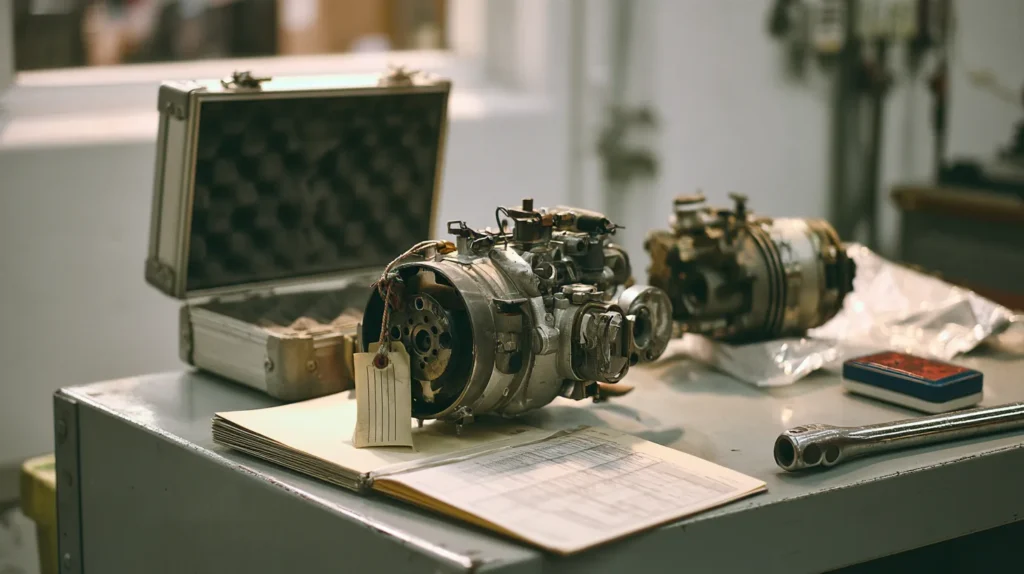
Component tracking is where a records system turns into an inventory system. Under M.A.305(d)(1) of Regulation (EU) No 1321/2014, the status records cover "life-limited parts, including the life accumulated by each affected part in relation to the applicable airworthiness limitation parameter". M.A.305(e)(3)(i) requires "an in-service history record for each life-limited part based on which the current status of compliance with airworthiness limitations is determined". M.A.503(a) sets the hard stop: "Installed life-limited parts and time-controlled components shall not exceed the approved limitation as specified in the AMP and ADs".
The AMC to M.A.305 adds granularity. For engines managed by module, "the total life accumulated in service for each module, as well as in-service history if applicable, and detailed maintenance records for each module, should be maintained." Life is not always measured by the aircraft either: "a mandatory life limitation measured in cycles of auxiliary power unit (APU) usage may apply to some rotating parts." Each component record identifies the "type, part number, serial number and registration, as appropriate, of the aircraft, engine, propeller, engine module, or component to which the component has been fitted in".
The resulting model is a part identity (part number plus serial number) with an installation history stored as intervals against a host, which may be an engine module or another component. Life counters accrue per limitation parameter while the part is installed (APU cycles count as a parameter of their own) and move with the part to its next host instead of being copied as a single total.
The CAMO-to-Part-145 Work Order and Handover
Maintenance starts with an order. Among the CAMO's tasks under CAMO.A.315(b)(6) of Regulation (EU) No 1321/2014 is to "order maintenance, supervise activities, and coordinate related decisions to ensure that any maintenance is carried out properly and is appropriately released". Under CAMO.A.315(d), "the contract may be in the form of individual work orders addressed to the maintenance organisation in the case of" two situations: an aircraft requiring unscheduled line maintenance, and component maintenance including engine and propeller maintenance.
Information has to flow back. Under 145.A.50(c) of the regulation, "New defects or incomplete maintenance work orders identified during the maintenance shall be brought to the attention of the person or organisation responsible for the aircraft continuing airworthiness". EASA's AMC to CAMO.A.220 says "The CAMO should ensure that it always receives a complete certificate of release to service from the approved maintenance organisation", and adds: "When a CAMO arranges for the relevant maintenance organisation to retain copies of the continuing airworthiness records on its behalf, it will nevertheless continue to be responsible for the records".
So the work order is the contract object between the two systems, going out with tasks and data references and coming back with a CRS, open tasks and new defects. Where the maintenance organization hosts records for the CAMO, the CAMO still needs its own read access and export.
Record Transfer on a Change of Operator or CAMO
Transfer is where timestamp-based retention breaks. Under M.A.307(a) of Regulation (EU) No 1321/2014, on a permanent transfer of the aircraft "the transferring owner or operator shall ensure that the continuing airworthiness records referred to in point M.A.305 and, if applicable the technical log system referred to in point M.A.306, are also transferred." M.A.307(c) says "The time periods for the retention of records set out in point (e) of point M.A.305 shall continue to apply to the new owner, operator, CAMO or CAO." EASA's AMC to M.A.307(a) treats a dry lease-out shorter than 6 months as generally not a permanent transfer.
Because the clocks continue, imports keep each record's original dates and CRS references; stamping the import date would restart retention.
Organizations have transfer duties of their own. Under CAMO.A.220(a)(8) of the regulation, "When the organisation ceases operations, all retained records shall be transferred to the owner of the aircraft." The sending side keeps clocks of its own from the table: a terminating Part-145 organization hands its last 3 years to the last customer or owner, or stores them as the competent authority specifies, and a transfer of management starts a CAMO's 3-year clock.
For the data itself, the AMC to M.A.305(e) says an IT system should "allow a transfer of the aircraft continuing airworthiness records data from one system to another using an industry-wide/worldwide data format or allow printing information". Printing meets that guidance but leaves the receiver rebuilding status records from paper, while a structured per-aircraft export makes the receiving CAMO's first status check a query.
Worked Example: One Work Package Across Three Holders
In this illustrative trace, with hypothetical dates, an aircraft under Part-M flown by an operator that keeps a technical log has a scheduled check at a Part-145 organization, which issues the CRS on 10 March 2027. Management moves to another CAMO on 1 July 2028, and the certifying engineer leaves the organization on 30 September 2028. Every period comes from the record-class table.
| Record from the check | Holder | Clock and rule | Earliest deletion in this trace |
|---|---|---|---|
| CRS entry in the record system | Operator | 30-day entry deadline, M.A.305(a) | Not a retention period; the entry is due by 9 April 2027 |
| Technical log entries for the check | Operator | 36 months prior to the last entry, M.A.305(e)(1) | Only once the newest log entry is dated after 10 March 2030, so the date moves while the aircraft flies |
| Scheduled maintenance record with its CRS | Operator | Until superseded, covering at least 36 months, M.A.305(e)(2)(iii) | No calendar date: only after a later equivalent record supersedes it and the kept records still cover 36 months |
| Work cards, detailed records and the CRS copy | Part-145 organization | 3 years from the CRS, 145.A.55(a)(3) | 10 March 2030 |
| Personnel record of the certifying engineer | Part-145 organization | At least 3 years after the person leaves, 145.A.55(d)(4) | 30 September 2031 at the earliest |
| CAMO work details for the check | First CAMO | 3 years after management is transferred, CAMO.A.220(a)(6) | 1 July 2031 |
| History of a life-limited part fitted during the check | Operator | No period stated, M.A.305(e)(3)(i) | None; the history moves with the part |
One check produces records under six retention rules held by three parties, and only the Part-145 copy has a deletion date that can be fixed on the day of the check, so a single expiry column cannot represent it.
From Rules to System Requirements
The AMC to M.A.305(e) states the integrity expectation directly: an IT system should "ensure the integrity of the data, including traceability of amendments". The rules and guidance above reduce to these build requirements, each argued in its own section.
- Recorded entries are append-only, and a correction is a linked new version that leaves the original visible (see the Part-M record system).
- Every CRS resolves to a person, the organization's approval number and the authorization the person held at that moment, with authorizations stored under validity dates instead of being overwritten (see the CRS section).
- Retention is computed per record from its triggering event, never from one table-wide expiry date (see the record-class table). The AMC to 145.A.55 adds: "The records should remain legible throughout the required retention period. The retention period starts when the record is created or was last amended." Under that Part-145 guidance, an amendment can move the clock of a record whose trigger the rule does not fix; where the rule names the trigger, such as the CRS date in 145.A.55(a)(3), the rule governs.
- Imports keep original dates, CRS references and provenance, and a tested per-aircraft export exists (see record transfer).
- Backups are monitored against the 24-hour window (see Part-145 records).
- Digitized paper keeps its own metadata. The Part-M AMC says "the creation date of the digitised record should be stored with the digitised record".
None of this requires a particular database, ledger technology or signature product, and the regulation names none.
How Do You Test a Records System Against These Rules?
Each rule above converts into an acceptance test that a staging copy of any candidate system can pass or fail before live records move.
- Correct a recorded entry. History, audit view and export must all keep it readable (M.A.305(g)).
- Take a CRS issued months ago, withdraw the signatory's authorization today, then query as of the release date. The system must show the authorization valid at signing, and the release must still resolve to the person and the organization's approval number.
- Export one aircraft and import it into an empty instance. Every entry must keep its original date and CRS reference, corrections must still sit beside their originals exactly as they appeared before the export, and no retention clock may restart at the import date, even for a record whose period has almost elapsed and regardless of which system originally created the export file (M.A.307(c)).
- Run the retention purge in simulation over a mixed data set. No record may be flagged before its own clock ends, whether that clock counts from a CRS, the newest log entry, supersession or a transfer of management, and records with no stated period must never be flagged by age alone.
- Raise an operation-affecting defect, defer it under a stated limitation, record the managing party's agreement, issue a CRS carrying the deferment and then rectify the defect under a new release. The technical log must show it open until rectification, with every state change dated (M.A.403, 145.A.50(e)).
- Send a work order from the CAMO to the maintenance organization and complete it with one new defect found. The CAMO side must receive the complete CRS and the new defect, and the CAMO must be able to read and export the resulting records itself (145.A.50(c)).
FAA Equivalents: 14 CFR 43.9, 43.11 and 91.417
A platform serving both EASA and FAA registries meets a different split of duties. Under 14 CFR 43.9, "each person who maintains, performs preventive maintenance, rebuilds, or alters an aircraft, airframe, aircraft engine, propeller, appliance, or component part shall make an entry in the maintenance record of that equipment", including "the signature, certificate number, and kind of certificate held by the person approving the work." And "The signature constitutes the approval for return to service only for the work performed." Inspection entries under 14 CFR 43.11 carry "The signature, the certificate number, and kind of certificate held by the person approving or disapproving for return to service", so the FAA writes signatory identity into the rule for every entry, while EASA places it in AMC for an aircraft release issued by a Part-145 organization and in the implementing rule for releases issued under M.A.801.
Retention under 14 CFR 91.417 is addressed to the registered owner or operator. Work records "shall be retained until the work is repeated or superseded by other work or for 1 year after the work is performed." Status records, such as life-limited part status and AD status, follow the aircraft: "The records specified in paragraph (a)(2) of this section shall be retained and transferred with the aircraft at the time the aircraft is sold." Neither regime's periods can be derived from the other's, so a dual-registry system configures retention classes per registry.
How Pharos Production Helps
If you are scoping a new records system or replacing one, our aviation software development team can start by checking your data model against the rules above. For how records fit beside operations, crew and cargo systems, see our aviation software development guide.
Sources: Commission Regulation (EU) No 1321/2014 on continuing airworthiness, consolidated text including Implementing Regulation (EU) 2026/100; European Union Aviation Safety Agency, Easy Access Rules for Continuing Airworthiness (AMC and GM to Part-M, Part-145 and Part-CAMO); 14 CFR 43.9, 14 CFR 43.11 and 14 CFR 91.417. Read 28 September 2026.
FAQ
Quick answers to common questions about custom software development, pricing, process and technology.
Type to filter questions and answers. Use Topic to narrow the list.
Showing all 6
No matches
Try a different keyword, change the topic or clear filters
-
How long must aircraft maintenance records be kept under EASA and FAA rules?
Under EASA rules there is no single period, because it follows the record class and the organization holding it, as the record-class table sets out. For aircraft under Part-M, an operator that must keep a technical log keeps it for the 36 months before its last entry, a Part-145 organization keeps its detailed records for 3 years from the release and a CAMO keeps its own work records for 3 years after management of the aircraft is transferred to another person or organization, while life-limited part histories carry no stated period.
Under 14 CFR 91.417 the registered owner or operator keeps work records until the work is repeated or superseded or for 1 year, and status records such as life-limited part and AD status are transferred with the aircraft when it is sold.
-
Does EASA require a digital signature on a certificate of release to service?
No. The implementing rule requires the release to be issued by authorized certifying staff and never names a signature technology. For a release by a Part-145 organization, EASA's acceptable means of compliance ask for the approval number and the identity of the person who issued the release, and the AMC for the aircraft continuing airworthiness records accepts electronic data through an approved electronically signed form without naming a standard.
What an organization should be able to show for an electronic signature is evidence rather than a product: who signed, that the signer held a valid certification authorization on the date of signing and that the entry cannot have been altered since without a visible trace. The organization has to show its competent authority that this evidence is acceptable, whatever mechanism produces it.
-
What happens to maintenance records when an aircraft is leased?
When an aircraft is permanently transferred to another owner or operator, the Part-M records, and the technical log where one is kept, go with it, and the retention periods keep running for the new holder. EASA's guidance treats a dry lease-out shorter than 6 months as generally not a permanent transfer, so the records system has to distinguish short leases from transfers instead of exporting on every change of operator.
-
Do these rules apply to light aircraft under Part-ML or to a CAO?
Not for Part-ML aircraft. Part-M applies to every aircraft in the regulation's scope except the lighter other-than-complex motor-powered aircraft listed in Article 3 of Regulation (EU) No 1321/2014, such as airplanes of 2,730 kg maximum takeoff mass or less, which follow Part-ML unless they are listed in the air operator certificate of a licensed air carrier.
Part-ML sets its own record system in ML.A.305, built around aircraft, engine and propeller logbooks and component log cards. A combined airworthiness organization keeps its records under CAO.A.090, which also covers the M.A.305 or ML.A.305 records of each aircraft it manages, so a CAO managing a Part-M aircraft applies the Part-M classes above. For Part-ML aircraft the pattern carries over, but record classes and periods come from that annex.
-
Can one records system serve both EASA and FAA registered aircraft?
Yes, if retention is configured per registry rather than hard-coded. Under 14 CFR 91.417, work records are kept until the work is repeated or superseded or for 1 year, while status records such as life-limited part and AD status transfer with the aircraft at sale.
EASA uses different periods and splits duties between the operator, the maintenance organization and the CAMO, so neither regime's rules can be derived from the other's.
-
What must be preserved when paper maintenance records are digitized?
EASA's acceptable means of compliance for aircraft continuing airworthiness records expect the creation date of the digitized record to be stored with it, and expect digitized records to be maintained against technological obsolescence that would prevent printing, displaying or retrieving them. The Part-145 guidance adds that records should remain legible throughout the required retention period.
In engineering terms the scan has to keep what gave the paper its evidential value, meaning the original entry date and the visible signature, with any correction still showing the original entry. The original date should stay a separate field from the digitization date, so retention is still computed from the event the rule names rather than from the scan.

I work with startup founders who need a dedicated software development team but don’t want to gamble on hiring, random outsourcing, or opaque delivery.
Most founders face the same problem sooner or later.
Early technical and team decisions lock the product into tech debt, slow delivery, missed milestones and constant re-hiring. By the time this becomes visible, fixing it is already expensive.As a CTO and software architect, I help founders design, build and run dedicated development teams that work as a true extension of the startup. Not as a black-box vendor.
My focus is on complex products where mistakes are costly:
- Web3 and blockchain platforms
- FinTech and regulated products
- High-load startup systems
- MVP → scale transitions
We don’t do body-shopping.
We don’t sell generic outsourcing.Instead, we help founders:
- build the right team structure from day one
- keep technical ownership and transparency
- scale delivery without losing control
- avoid vendor lock-in and hidden risks
Teams are aligned with the product roadmap, business goals and long-term architecture. Not just short-term velocity.