Automotive Software Development in 2026: Types, Cost and Build Guide
Automotive software development in 2026: embedded, ADAS, infotainment and connected-car types, build vs buy, costs and timelines by scope.
 Updated
7 min read
206 views
Updated
7 min read
206 views
Key takeaways: automotive software development in 2026 5
The main system types, safety-driven cost and where custom wins.
- Name the type first Embedded, ADAS, infotainment, connected-car or companion app - each is a different world of cost.
- Safety is the cost line Whether code can affect vehicle motion - and so carries ISO 26262 - is the single biggest driver.
- Cost by safety and scope $80K-$250K a non-safety module, $250K-$1M a platform, $1M-$5M and up safety-critical or SDV.
- Standards are mandatory AUTOSAR, ISO 26262, ASPICE and UNECE R155/R156 shape the program from day one, not later.
- AI is high-value, hard ADAS perception and in-cabin AI pay off but carry safety and validation burdens beyond typical ML.
"Automotive software" runs from a companion phone app to safety-critical code that drives the car itself, so the cost and the build swing enormously with what you are actually making - a non-safety app and an ISO 26262 ADAS module sit a decimal point apart. The job is to name the system you need - embedded control, ADAS, infotainment, a connected-car platform - then decide whether to build, buy or partner. This guide explains automotive software development in 2026: the main types, build versus buy, what drives the cost and the honest ranges, before you scope a project with an automotive software development partner.
In short: automotive software spans embedded control (ECUs and AUTOSAR), ADAS and autonomous driving, infotainment and the digital cockpit, connected-car and telematics, and companion apps with OTA updates. A non-safety module or MVP costs roughly $80,000 to $250,000 over 4 to 8 months. A mid-size infotainment or connected-car platform or an ADAS component runs $250,000 to $1M over 8 to 18 months. A safety-critical build under ISO 26262, or a software-defined-vehicle platform, reaches $1M to $5M and up over 18 to 36 months. The dividing line is functional safety: code that can move or stop the car carries ISO 26262, AUTOSAR and cybersecurity obligations far costlier than a typical app. Tier-1 suppliers cover much of the stack; custom development earns its place where the experience, data or differentiating feature is yours.
What automotive software is, and its main types
Automotive software runs, connects and enhances the vehicle, from the silicon up to the cloud. It is not one product but a family of systems, and most projects are one or two of them rather than all at once. The main types are embedded control (the ECUs and real-time code that run the car's functions), ADAS and autonomous driving (perception and decision-making for safety and self-driving), infotainment and the digital cockpit (the screens and experience inside), connected-car and telematics (the vehicle's link to the cloud and other vehicles), and companion apps with OTA (the owner's phone app and the ability to update the car remotely). Naming which of these you need is the single most important scoping decision, because a safety-critical build and a companion app are entirely different worlds of cost and process.
The core systems explained
Embedded control (ECU / AUTOSAR): the real-time software on electronic control units that runs powertrain, braking, body and chassis functions, usually built to the AUTOSAR standard. The foundation everything else sits on.
ADAS and autonomous driving: perception (camera, radar, lidar), sensor fusion and decision software for features from lane-keeping and emergency braking up to higher autonomy. The most safety-critical and demanding domain.
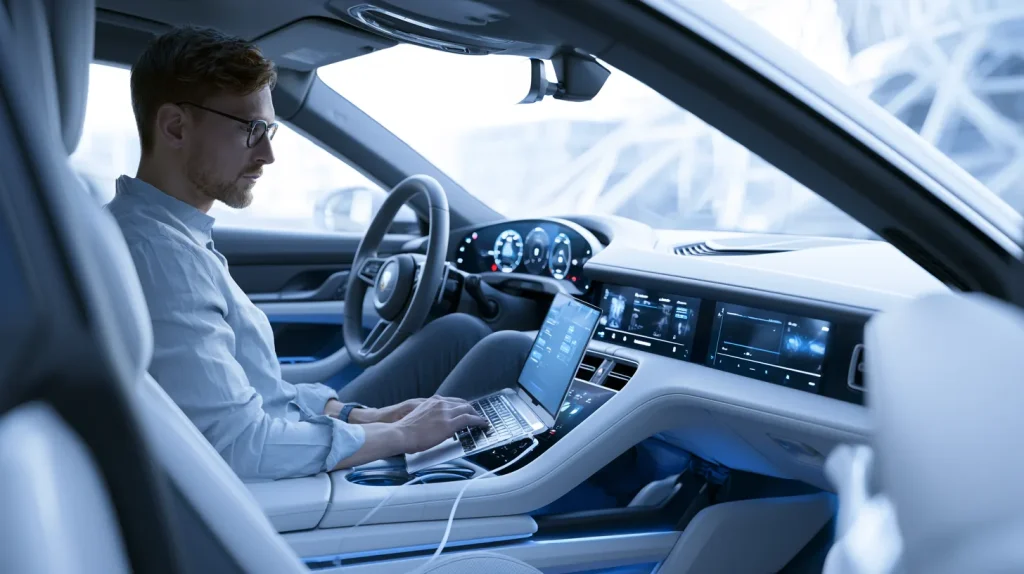
Infotainment and digital cockpit: the in-vehicle infotainment (IVI) system and instrument cluster - navigation, media, voice, apps and the whole screen experience, increasingly built on Android Automotive or a custom stack.
Connected car and telematics: the link between vehicle and cloud - telematics, remote diagnostics, V2X communication, fleet data and the backend that ingests and acts on it.
Companion apps and OTA: the owner's mobile app for remote control, status and services, and the over-the-air pipeline that updates vehicle software safely after it ships.
Build, buy or partner
The first cost decision is build versus buy. Much of the automotive stack comes from Tier-1 suppliers and platform vendors - AUTOSAR stacks, ADAS toolchains, Android Automotive for infotainment - and reinventing the regulated, safety-critical primitives is slow and risky. Custom software is the right call when the in-car experience, the connected-car data and services, or a differentiating feature is your competitive advantage, when you need integrations the platforms do not support, or when you are a software-led OEM or startup building your own platform. Most programs are a hybrid: standards-based, supplier-provided embedded and safety layers, with custom infotainment, connected services, companion apps and a cloud backend built on top. The custom layer is where the brand experience and the new revenue sit. Standards and suppliers dominate the safety layer.
What drives automotive software cost
Within any type, the same factors move the number. Safety criticality - whether the code can affect vehicle motion - is the single biggest driver, because ISO 26262 functional safety brings rigorous process, documentation and testing. Standards and process - AUTOSAR, ASPICE and cybersecurity rules (UNECE R155/R156) add mandatory, audited work. Hardware and real-time - embedded targets, limited compute and hard real-time constraints make the engineering harder than cloud software. Integration - many ECUs, networks (CAN, automotive Ethernet) and supplier components must work together. And AI - ADAS perception and autonomous features add model, data, validation and enormous testing work on top of the application.
Automotive software cost and timeline in 2026
Ranges track safety criticality and integration depth more than anything else.
Non-safety module / MVP: $80,000 to $250,000, 4 to 8 months. A companion app, a telematics dashboard or an infotainment feature - real engineering, but outside the safety-critical path.
Mid-size platform / component: $250,000 to $1M, 8 to 18 months. An infotainment or connected-car platform, or an ADAS component, with cloud and vehicle integration.
Safety-critical / SDV platform: $1M to $5M and up, 18 to 36 months. ISO 26262 embedded or ADAS software, or a software-defined-vehicle platform across many ECUs, with full safety and cybersecurity process.
On top of build cost, budget ongoing maintenance, an OTA pipeline and cloud infrastructure that scales with the fleet, plus the long tail of validation. For a wider view of lifetime cost, see our custom software TCO report.
Standards and integrations that matter
Automotive software lives or dies on standards and integration, because it must be safe, secure and interoperable. The core set is AUTOSAR for embedded architecture, ISO 26262 for functional safety, ASPICE for process maturity and UNECE R155/R156 for cybersecurity and software update management. On the technical side it is in-vehicle networks (CAN, LIN, automotive Ethernet), the OTA pipeline, and the cloud backend for telematics and connected services. The safety and security standards are not optional and they shape the whole program from day one - retrofitting them is far more expensive than building to them. The connected and companion side leans on solid cloud, IoT and mobile engineering, which we cover in our IoT development and mobile app development cost guides.
AI in automotive in 2026
The clearest returns - and the hardest engineering - come from AI. ADAS and autonomous perception use computer vision and sensor fusion to understand the road. Predictive maintenance uses vehicle data to flag failures before they happen. In-cabin AI powers voice assistants, driver monitoring and personalization, while fleet analytics optimize routing and uptime. These add significant cost, because automotive AI carries validation and safety burdens far beyond typical machine learning, but they are central to the modern vehicle. We cover the foundations in our guides to computer vision and machine learning for business.
Common mistakes
The expensive errors repeat. Underestimating functional safety and treating ISO 26262 as paperwork to add later, when it must shape architecture and process from the start. Building safety-critical primitives from scratch instead of using proven AUTOSAR and supplier stacks. Ignoring cybersecurity (UNECE R155) until type approval, then scrambling. Treating OTA as a feature rather than a safety-grade pipeline that has to update cars without bricking them. And applying cloud-software assumptions to hard real-time embedded targets, then missing timing and memory constraints.
How to decide
Start by naming the system you actually need - embedded control, ADAS, infotainment, connected-car or a companion app - because that, and especially whether it is safety-critical, sets the band more than anything else. If it can affect vehicle motion, build to ISO 26262, AUTOSAR and cybersecurity standards with the right partners. If it is experience, connectivity or apps, custom software is where the brand and revenue advantage comes from. Most OEMs and suppliers land on a hybrid and invest the custom budget where the differentiation is. If you are scoping an automotive build, our automotive software development team can map the type, safety and standards, integrations, cost and timeline with you, from a companion app to a software-defined-vehicle platform.
FAQ
Quick answers to common questions about custom software development, pricing, process and technology.
Type to filter questions and answers. Use Topic to narrow the list.
Showing all 8
No matches
Try a different keyword, change the topic or clear filters
-
A non-safety module or MVP - a companion app, a telematics dashboard or an infotainment feature - costs roughly $80,000 to $250,000 over 4 to 8 months. A mid-size infotainment or connected-car platform, or an ADAS component, runs $250,000 to $1M over 8 to 18 months. A safety-critical embedded or ADAS build under ISO 26262, or a software-defined-vehicle platform, reaches $1M to $5M and up over 18 to 36 months. Functional safety is the dividing line.
-
Use Tier-1 suppliers and platforms for the regulated, safety-critical primitives - AUTOSAR stacks, ADAS toolchains, Android Automotive - because reinventing them is slow and risky. Build custom where the in-car experience, connected-car data and services or a differentiating feature is your advantage, or you are a software-led OEM building your own platform. Most programs are a hybrid: supplier-provided safety layers with custom infotainment, services and apps on top.
-
A software-defined vehicle (SDV) is a car whose features and value come mainly from software that can be updated over the air, built on a centralized compute platform instead of many fixed-function ECUs. It lets carmakers add features, fix issues and sell services after the car ships. It is the direction the whole industry is moving, and it reshapes how automotive software is architected.
-
A non-safety module or MVP ships in 4 to 8 months, a mid-size platform or ADAS component in 8 to 18 months and a safety-critical or software-defined-vehicle build in 18 to 36 months or more. Functional safety (ISO 26262), standards process and the enormous validation and testing burden usually set the schedule far more than the core feature work.
-
The core set is AUTOSAR for embedded architecture, ISO 26262 for functional safety, ASPICE for process maturity and UNECE R155 and R156 for cybersecurity and software update management. Anything that can affect vehicle motion must meet functional-safety and cybersecurity standards, and they shape the whole program from day one - retrofitting them is far more expensive than building to them.
-
The clearest uses are ADAS and autonomous perception (computer vision and sensor fusion to understand the road), predictive maintenance (flagging failures from vehicle data), in-cabin AI (voice assistants, driver monitoring and personalization) and fleet analytics. Automotive AI carries validation and safety burdens far beyond typical machine learning, which is why it is both high-value and expensive.
-
ADAS (Advanced Driver Assistance Systems) supports the driver with features like lane-keeping, adaptive cruise and emergency braking - the human is still in control. Autonomous driving aims for the vehicle to drive itself at higher levels of automation. They share perception and decision software, but autonomy raises the safety, validation and cost bar dramatically.
-
Functional safety (ISO 26262) governs any software that can affect vehicle motion, and cybersecurity (UNECE R155) and software update management (R156) are required for type approval. These are mandatory and audited, and they must shape architecture, process and the OTA pipeline from the start. They are a large part of why safety-critical automotive software costs far more than a typical app.
Automotive software glossary 8
- ECU (electronic control unit)
- An embedded computer that runs a specific vehicle function - powertrain, braking, body. A modern car has dozens to over a hundred, and the real-time software on them is the foundation of automotive software.
- AUTOSAR
- The standardized software architecture for automotive ECUs that lets suppliers and OEMs build interoperable, reusable embedded software. The default framework for serious embedded automotive work.
- ADAS
- Advanced Driver Assistance Systems - features like lane-keeping, adaptive cruise and emergency braking, built on camera, radar and lidar perception. The most safety-critical software domain in the car.
- Software-defined vehicle (SDV)
- A car whose features and value are driven by software that can be updated over the air, built on a centralized compute platform rather than many fixed-function ECUs. The direction the whole industry is moving.
- Infotainment / IVI
- In-vehicle infotainment - the screens and experience inside the car for navigation, media, voice and apps, increasingly built on Android Automotive or a custom stack and tied to the digital cockpit.
- Telematics / V2X
- The vehicle's connectivity - telematics for remote data and diagnostics, and V2X for communicating with other vehicles and infrastructure. The link between car and cloud.
- OTA updates
- Over-the-air software updates that fix, secure and add features to a vehicle after it ships. A safety-grade pipeline, not a simple app update, governed by cybersecurity standards.
- ISO 26262
- The functional-safety standard for road vehicles. Any software that can affect vehicle motion must be developed to it, with rigorous process, documentation and testing - the single biggest cost driver in automotive software.

I work with startup founders who need a dedicated software development team but don’t want to gamble on hiring, random outsourcing, or opaque delivery.
Most founders face the same problem sooner or later.
Early technical and team decisions lock the product into tech debt, slow delivery, missed milestones and constant re-hiring. By the time this becomes visible, fixing it is already expensive.As a CTO and software architect, I help founders design, build and run dedicated development teams that work as a true extension of the startup. Not as a black-box vendor.
My focus is on complex products where mistakes are costly:
- Web3 and blockchain platforms
- FinTech and regulated products
- High-load startup systems
- MVP → scale transitions
We don’t do body-shopping.
We don’t sell generic outsourcing.Instead, we help founders:
- build the right team structure from day one
- keep technical ownership and transparency
- scale delivery without losing control
- avoid vendor lock-in and hidden risks
Teams are aligned with the product roadmap, business goals and long-term architecture. Not just short-term velocity.