
Last reviewed
InsuranceNexora Insurance Platform. Underwriting, Policy and Claims Operations
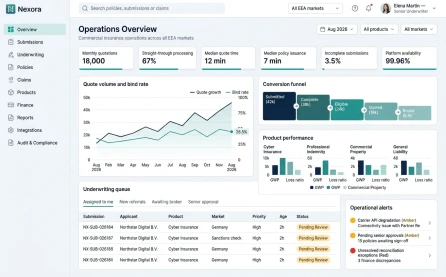
Four insurance product lines ran on spreadsheets, email and carrier portals until Nexora Insurance Platform, a single cloud platform, brought submission, underwriting, policy issuance and claims intake into one auditable workflow. Standard policies that once took up to a business day to issue now clear in minutes, and monthly quote volume has grown to 18,000 without a matching expansion of the operations team.
- 2023 Client since
- Insurance Industry
- Europe Region




Overview of the Project
-
The challenge
The client is a European specialty insurance broker and managing general agent (MGA) serving small and midsize businesses across five European Economic Area markets, with lines spanning professional indemnity, cyber insurance, commercial property and general liability. Each line had grown its own spreadsheets and carrier reporting process, and the same customer and risk data was reentered three or four times across the CRM, an underwriting spreadsheet, a carrier portal and the accounting system.
-
Where the time went
A standard quotation took about 45 minutes of staff time, and complex commercial risks took two to three hours before underwriting had even started its review. Roughly 12% of submissions came back to the broker as incomplete, because there was no centralized validation at intake, and underwriting rules lived in spreadsheets with version drift, so the client could not reliably say which rating table had been used or why a risk was accepted or declined. Issuing a straightforward policy took four hours to a full business day, and several days when a referral or corrected document was involved, which cost conversions in a market where prospects buy from whoever answers first. Endorsements, cancellations and renewals ran on email with no single versioned policy record, and monthly carrier bordereaux took five to seven business days to assemble by hand. Discovery found that roughly 27% of the operations team's capacity went to duplicate data entry, document preparation and reconciliation, a cost the client could not absorb against a plan to nearly double distribution volume within two years.
What We Built
-
Product configuration and controls
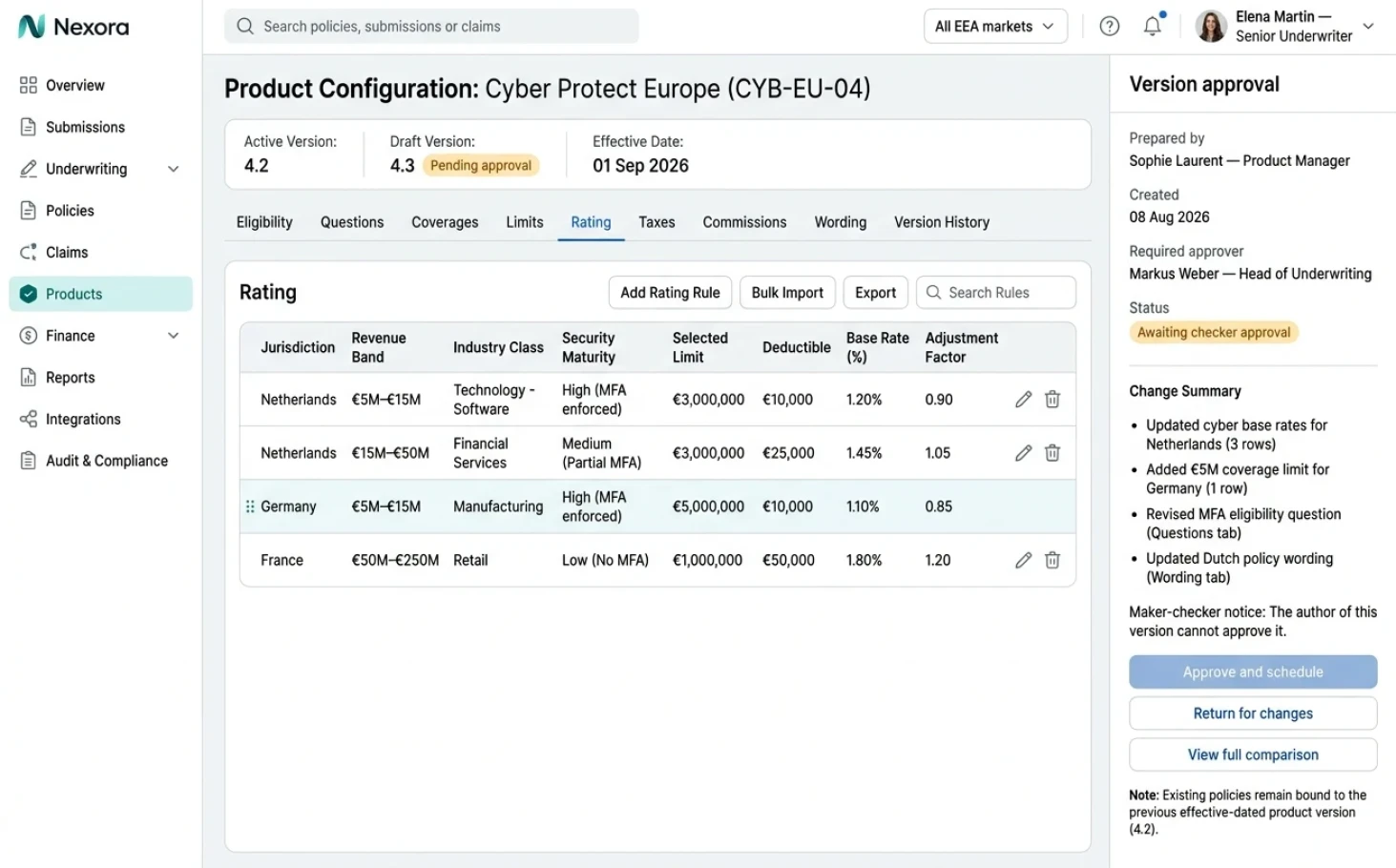
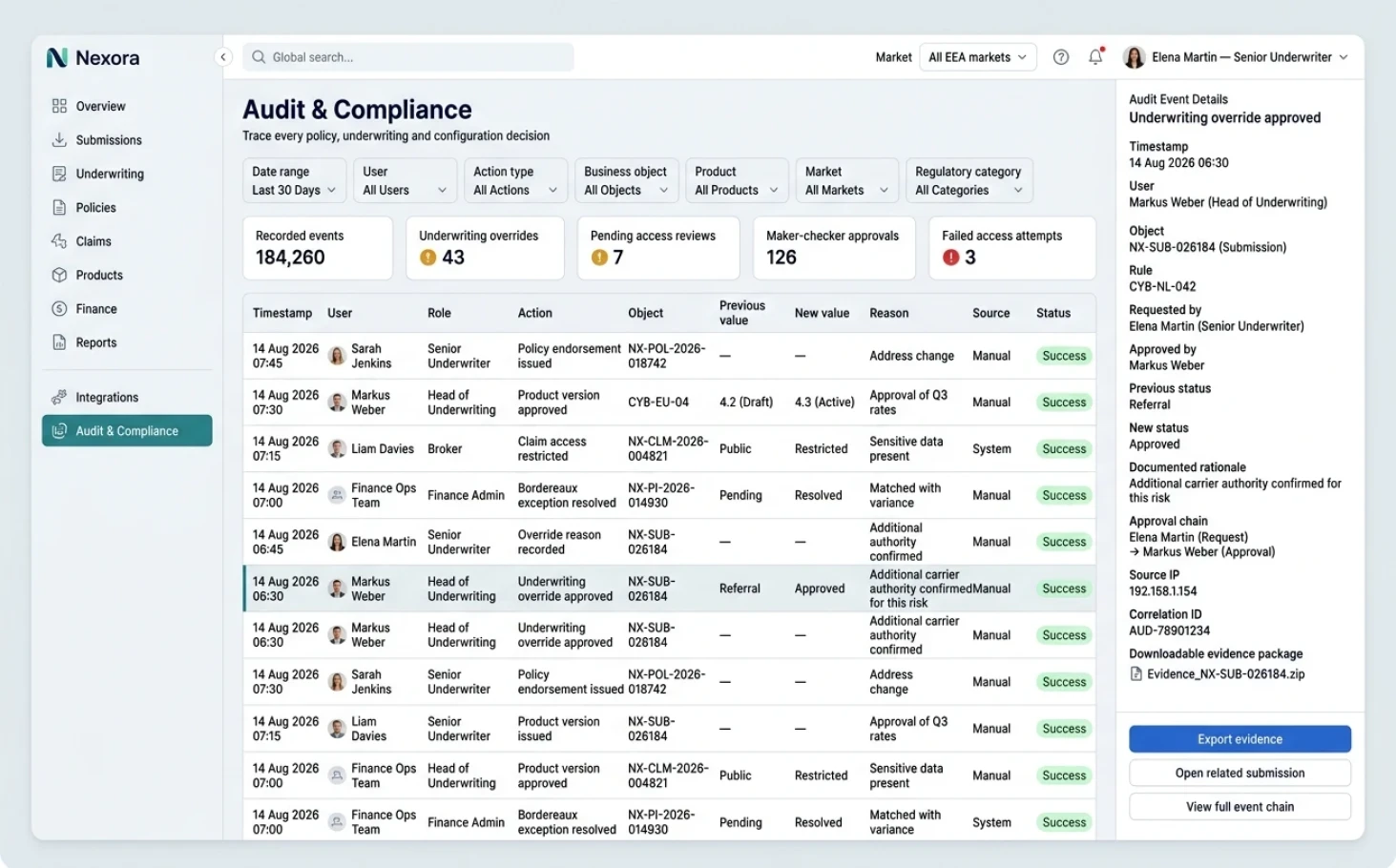
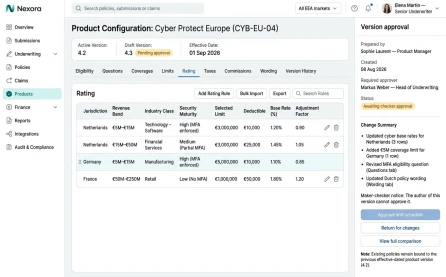
Nexora, the platform we built, centers on a centralized, effective-dated product configuration covering eligibility rules, underwriting questions, coverages, limits, rating tables, taxes, commissions and policy wording. A policy issued under an earlier version stays bound to the exact rules and rates in force on its effective date, and any change goes through maker-checker approval, with one person preparing a version and a second authorized person approving it before activation.
-
From submission to underwriting decision
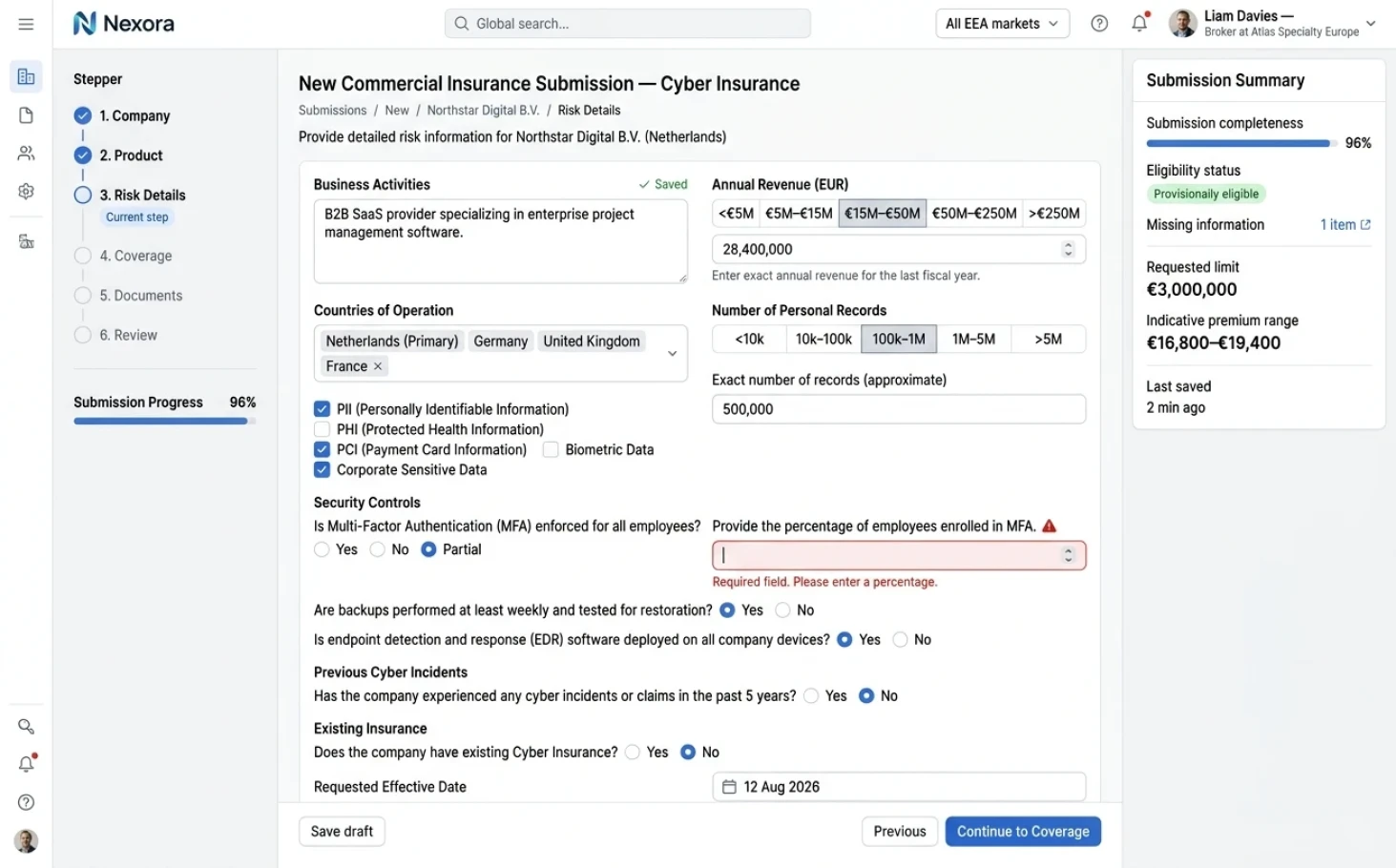
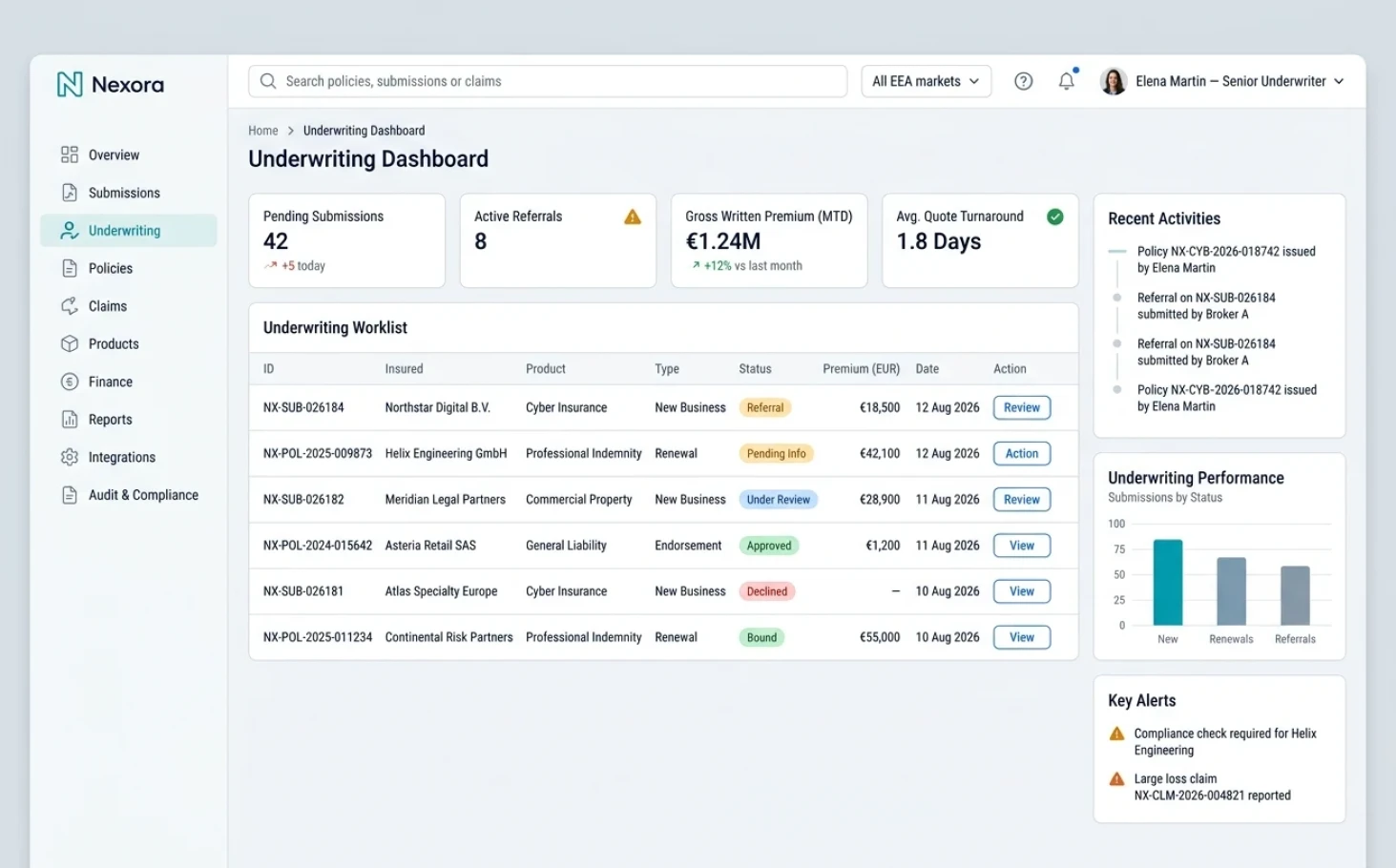
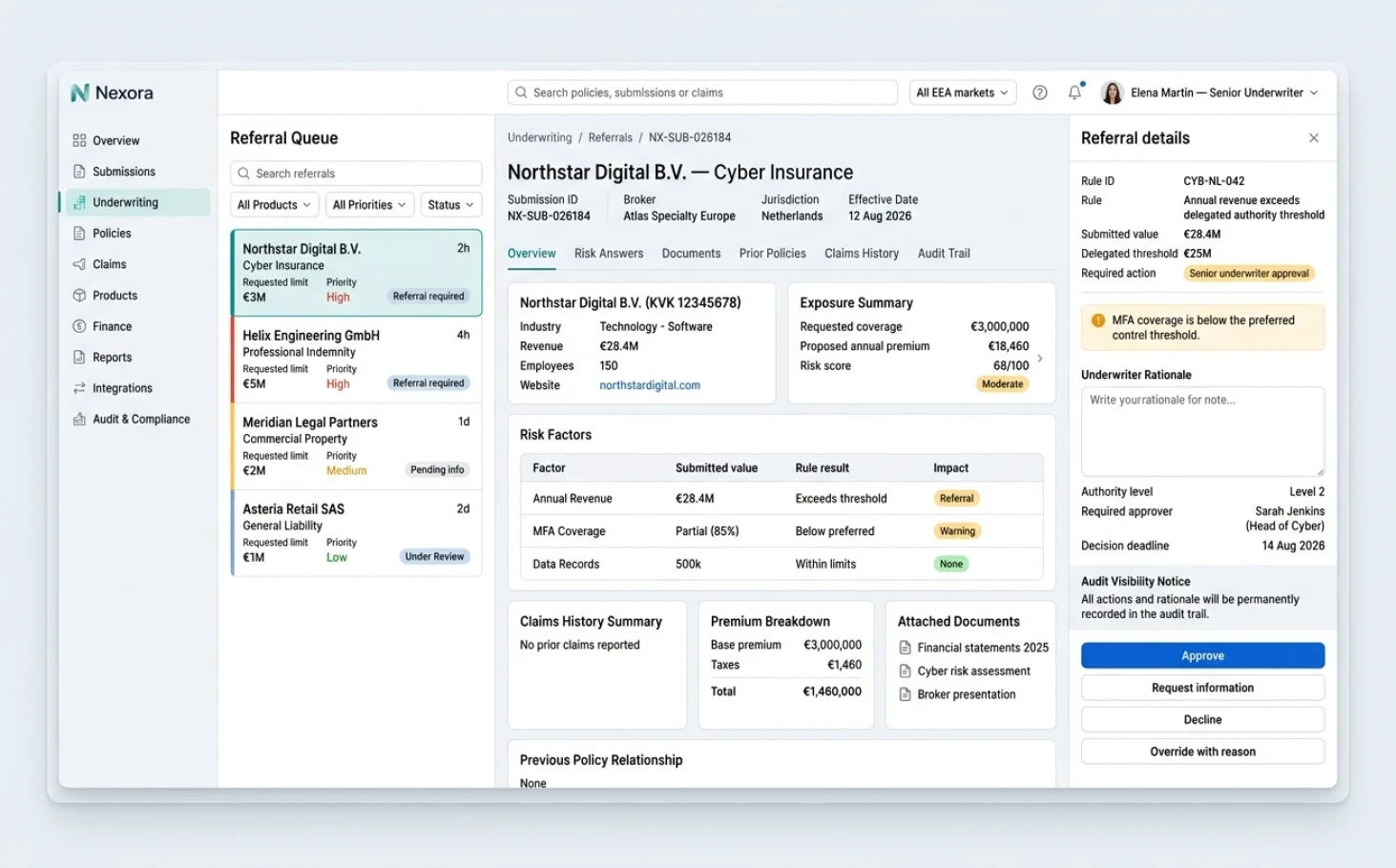
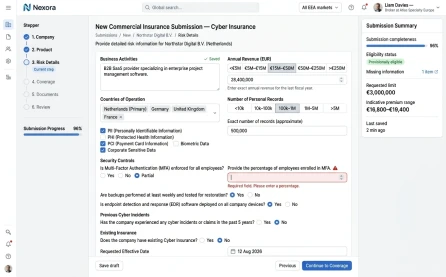
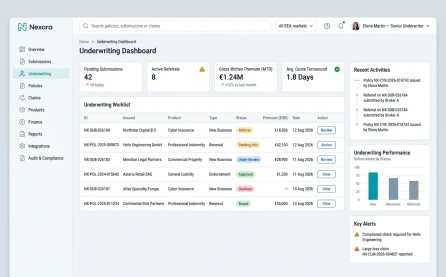
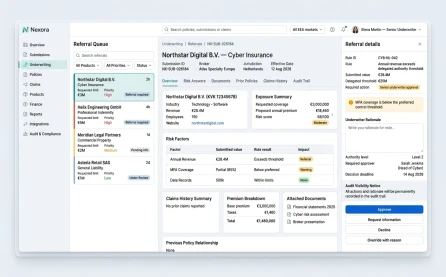
Brokers submit through a portal whose forms adapt dynamically to product, jurisdiction and business type, with validation before anything reaches underwriting. The quotation workflow runs automatic eligibility checks and deterministic risk scoring, and routes each risk either straight through, when it sits inside the carrier's delegated authority, or to an underwriter workbench that shows the specific rule that triggered the referral alongside prior policies and claims history. Overrides require an authorized role, a documented reason and, above a risk threshold, senior underwriter sign-off.
-
Policy lifecycle, claims and reconciliation
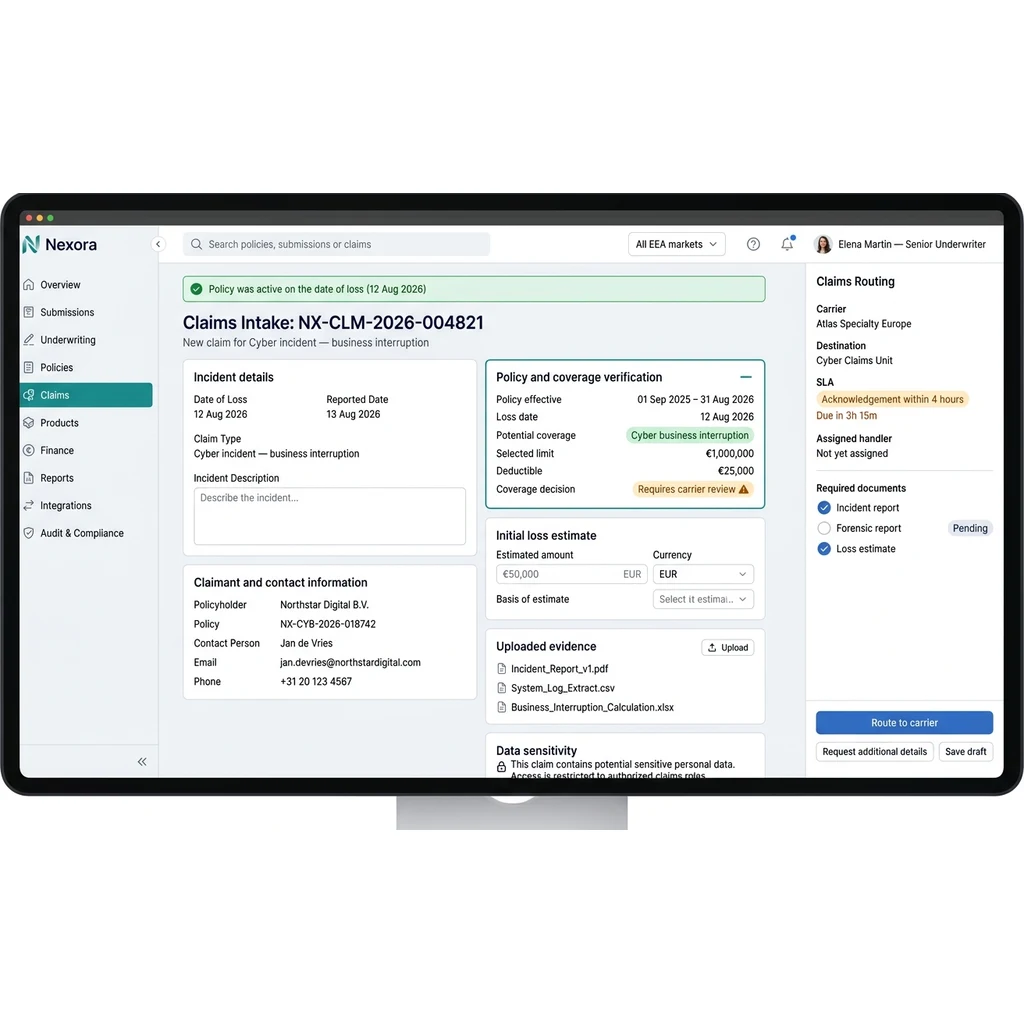
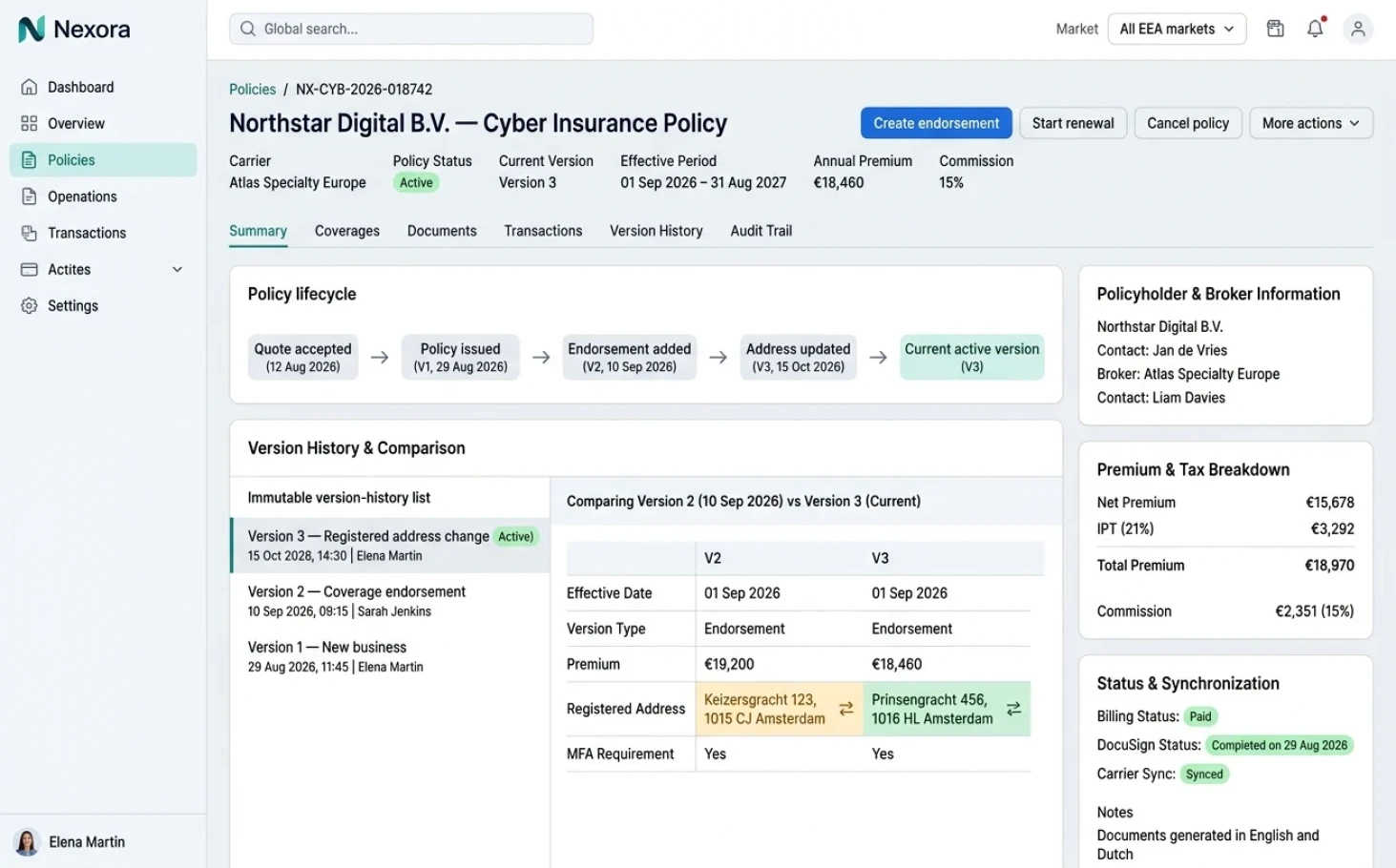
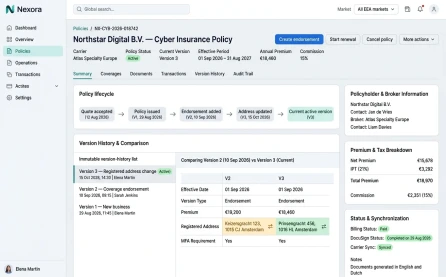
Policy administration manages the full lifecycle: every endorsement, renewal or cancellation creates a new immutable version tied to its predecessor, recalculating premium and commissions and generating versioned documents in English, German, Dutch and French with DocuSign e-signature gating the workflow. Claims intake verifies that the policy was active on the date of loss and routes it to the right carrier or handler rather than making an automatic decision, and a financial module produces carrier-specific bordereaux with automated reconciliation.
-
Integrations and legacy migration
Nexora's integration reaches six carrier systems, two claims and TPA systems, Salesforce, Microsoft Dynamics 365 Business Central, DocuSign and Adyen. Migration moved roughly 70,000 active policies, 250,000 historical policies and 1.2 million documents onto the new platform. Hardest to engineer were keeping configuration changes from ever touching an already-issued policy, running workflows that stay open for weeks, and making every integration idempotent enough that a carrier resend cannot create a duplicate policy or payment.
Regulatory and Compliance
-
Insurance Distribution Directive
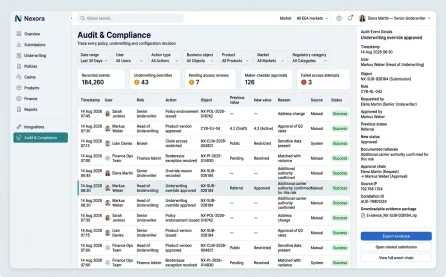
The Insurance Distribution Directive (IDD) is the governing EU framework for how the client distributes cover, and the platform supports it with structured demands-and-needs questionnaires, versioned precontractual disclosures, records of advised versus non-advised sales and commission and complaint tracking. None of this replaces legal or compliance judgment. It enforces the approved process and preserves evidence that the process was followed.
-
GDPR, Solvency II and DORA
GDPR requirements shaped the architecture from hosting up: EU-based infrastructure, encryption in transit and at rest, role-based access control and multifactor authentication. Health information tied to bodily injury claims is restricted to designated claims roles and excluded from underwriting dashboards, and the project included a formal data protection impact assessment. Solvency II reporting remains the carriers' obligation rather than a direct capital requirement on the broker, so the platform's job is supplying accurate, reconciled data with lineage back to the source transaction. DORA applied too, given the client's classification and size, targeting a two-hour recovery time objective and a 15-minute recovery point objective for core policy data. An independent penetration test ran before full production rollout, with critical and high-severity findings resolved before launch.
Business Results
-
Cycle time and straight-through processing
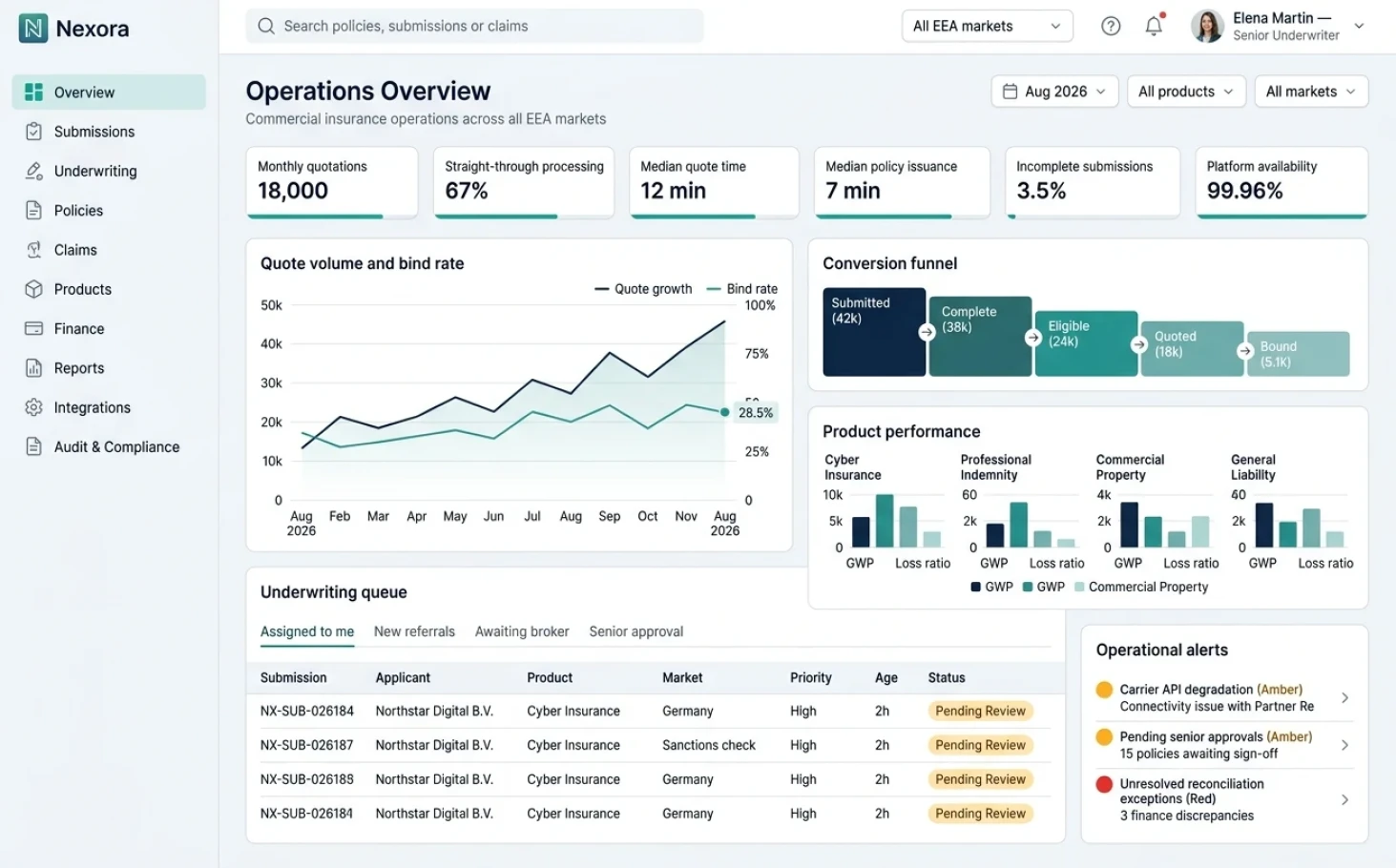
The results show up first in cycle time: automatic eligibility checks and straight-through routing cut median processing time for a standard quotation from about 45 minutes to about 12 minutes, and the share of eligible submissions handled straight through without manual underwriting rose from zero to 67%. Standard policy issuance dropped from four hours to a full business day down to a median of seven minutes, while submissions returned for missing information fell from around 12% to about 3.5%. Automated reconciliation cut the monthly carrier bordereaux cycle from five to seven days down to about four hours, and manual data entry and reconciliation effort overall fell 58%.
-
Conversion, cost and scale
Quote-to-bind conversion improved from around 24% to 28.5%, driven mainly by faster response and fewer incomplete applications, and operating cost per newly issued policy dropped 34%. Within twelve months of rollout, monthly quotation volume grew to 18,000 while the operations team itself grew only about 8%, well below the 12 to 15 additional hires the old model would have required. Production availability held at 99.96% across the first year in service.
How We Worked
-
Timeline and delivery phases
The engagement ran roughly 14 months from discovery to full multi-country rollout: six weeks of discovery, about 22 weeks building the core platform and MVP, roughly 12 weeks of production pilot and hardening, and 16 weeks of carrier integration, migration and rollout.
-
Team and engagement model
Team size averaged 11 specialists and grew to 13 during migration: a solution architect, an insurance-domain analyst, four backend engineers, two frontend engineers, two QA engineers and a site reliability engineer. The client matched that with a product owner, a head of underwriting and representatives from operations, claims, compliance and finance.
The commercial model was hybrid. Discovery ran fixed-price with defined deliverables, and the implementation phases ran as a dedicated team on time and materials, with a monthly budget cap and two-week sprints. A single fixed-price contract for the whole program would have needed a large contingency and made it harder to adjust scope as carrier integrations and regulatory interpretations evolved, so the dedicated-team model carried the bulk of the build. The client received source code, infrastructure-as-code, database schemas, API documentation and runbooks at handover, and post-rollout support covers defect resolution and carrier integration maintenance, with 24/5 coverage for normal incidents and on-call escalation for critical ones.
Project Outcome
67% straight-through underwriting with standard policies issued in a median of 7 minutes
Project Gallery
Client Feedback
They gave our underwriting, operations and compliance teams one controlled workflow from submission through policy issuance and claims intake. Standard policies now move from quote to issue in minutes, and carrier reporting is produced the same day, without building a larger back office.