Agriculture Software Development in 2026: AgriTech Types, Cost and Build Guide
Agriculture software development in 2026: farm management, precision ag, IoT, drone imagery and livestock types, build vs buy, costs and timelines.
 Updated
7 min read
198 views
Updated
7 min read
198 views
Key takeaways: agriculture software development in 2026 5
The main AgriTech types, build vs buy and the real cost ranges by scope.
- Name the type first FMS, precision ag, IoT/irrigation, drone imagery or livestock - each is a different build and data set.
- Data fusion is the cost Harmonizing satellite, sensor, weather and machine data is the biggest and most underestimated driver.
- Cost by scope $50K-$150K a module, $150K-$500K a platform, $500K-$2M and up an enterprise precision-ag build.
- Design offline-first Farms have patchy networks - assume offline, sync later, process at the edge.
- AI and IoT pay off Vision crop analysis, yield models and variable-rate are where yield and input savings are.
"Agriculture software" stretches from a simple farm record-keeping app to a precision-agriculture platform that fuses satellite imagery, field sensors and machine data to steer every acre, so the cost and the build swing widely with what you are actually making. The job is to name the system you need - a farm management system, a precision-ag platform, an IoT and irrigation layer, a livestock or traceability tool - then decide whether to buy, customize or build it. This guide explains agriculture software development in 2026: the main AgriTech types, build versus buy, what drives the cost and the honest ranges, before you scope a project with an agriculture software development partner.
In short: agriculture (AgriTech) software spans farm management systems (FMS), precision agriculture and field mapping, IoT sensors and irrigation, drone and satellite imagery, and livestock and supply-chain traceability. A single custom module or MVP costs roughly $50,000 to $150,000 over 3 to 6 months. A mid-size FMS or precision-ag platform with IoT, mapping and integrations runs $150,000 to $500,000 over 6 to 14 months. An enterprise platform with drone and satellite analytics and AI reaches $500,000 to $2M and up over 12 to 24 months. Off-the-shelf platforms like John Deere Operations Center or Climate FieldView start fast but lock you into their ecosystem; custom wins when your agronomy, data or workflow is the differentiator. Field data integration and rural connectivity make AgriTech builds harder than typical business software.
What agriculture software is, and its main types
Agriculture software plans, monitors and optimizes growing crops and raising livestock, turning field and machine data into decisions. It is not one product but a family of systems, and most projects are one or two of them rather than all at once. The main types are farm management systems (the operational record and planning hub), precision agriculture and mapping (field-level, data-driven decisions), IoT sensors and irrigation (real-time soil, weather and water control), drone and satellite imagery (crop health from above), and livestock and traceability (animal monitoring and farm-to-fork provenance). Naming which of these you need is the single most important scoping decision, because each is a different build with different data sources.
The core systems explained
Farm management system (FMS): the operational hub - fields, crops, tasks, inputs, equipment, labor and costs - that records what happens and plans the season. The backbone most farms start with.
Precision agriculture and mapping: field-level decisions from data - GIS maps, soil zones, yield maps and variable-rate prescriptions that apply seed, fertilizer and water exactly where needed.
IoT sensors and irrigation: soil-moisture, weather and crop sensors plus connected irrigation and equipment, feeding real-time data and automating water and inputs.
Drone and satellite imagery: aerial and satellite imagery analyzed with computer vision for crop health, stress, pests and yield estimates across whole fields.
Livestock and traceability: animal health, feeding and movement monitoring, plus farm-to-fork traceability that proves provenance and meets food-safety and export rules.
Build, buy or customize
The first cost decision is build versus buy. Off-the-shelf platforms - John Deere Operations Center, Climate FieldView, Granular and many regional FMS tools - cover standard processes and start fast, but you fit your operation to their model and lock into their ecosystem and data, and deep customization gets expensive. Custom software is the right call when your agronomy models, your data assets or your farmer experience are a competitive advantage, when you need integrations the platforms do not support, or when you are an AgriTech vendor building a product to sell. Many operators run a hybrid: an off-the-shelf FMS or machine platform for the basics, with custom apps - an analytics layer, a grower marketplace, a CV pipeline - built around it. The custom layer is usually where the differentiation and the value sit.
What drives agriculture software cost
Within any type, the same factors move the number. Scope - one app versus a multi-source precision platform. Data integration - pulling and harmonizing satellite, weather, sensor, machine and GIS data is the biggest and most underestimated driver. Connectivity - farms have patchy rural networks, so offline-first design and edge processing add real work. Hardware - sensors, gateways, drones and machine telematics add device integration. Imagery and AI - computer-vision crop analysis and yield models need data, labeling and validation. And scale - multi-farm, multi-region and multi-crop support multiplies the effort.
Agriculture software cost and timeline in 2026
Ranges track scope and data-integration depth more than anything else.
Single module / MVP: $50,000 to $150,000, 3 to 6 months. One focused system - a farm app, a monitoring dashboard or a grower marketplace MVP - with core data and one or two integrations.
Mid-size platform: $150,000 to $500,000, 6 to 14 months. A full FMS or precision-ag platform with IoT, field mapping, weather and machine integrations, dashboards and reporting.
Enterprise platform: $500,000 to $2M and up, 12 to 24 months. Drone and satellite analytics, AI yield and disease models, IoT at scale and multi-farm, multi-region rollout.
On top of build cost, budget 15 to 20 percent of it per year for maintenance, plus satellite and weather data fees, infrastructure that scales with fields and devices, and new integrations as machinery and partners change. For a wider view of lifetime cost, see our custom software TCO report.
Integrations and data that matter
Agriculture software lives or dies on its data and integrations, because the value is in fusing many sources. The usual set is IoT soil, weather and crop sensors, farm machinery and telematics (often over the ISOBUS standard), satellite and drone imagery providers, weather and climate data, GIS and mapping, and the ERP, accounting or marketplace systems the business runs on. The hard part is harmonizing heterogeneous field data - different formats, units and reliability - into one trustworthy picture, and doing it where rural connectivity is poor. That data layer is the largest share of most AgriTech budgets, and the connected-device side leans on solid IoT engineering.
AI and IoT in agriculture in 2026
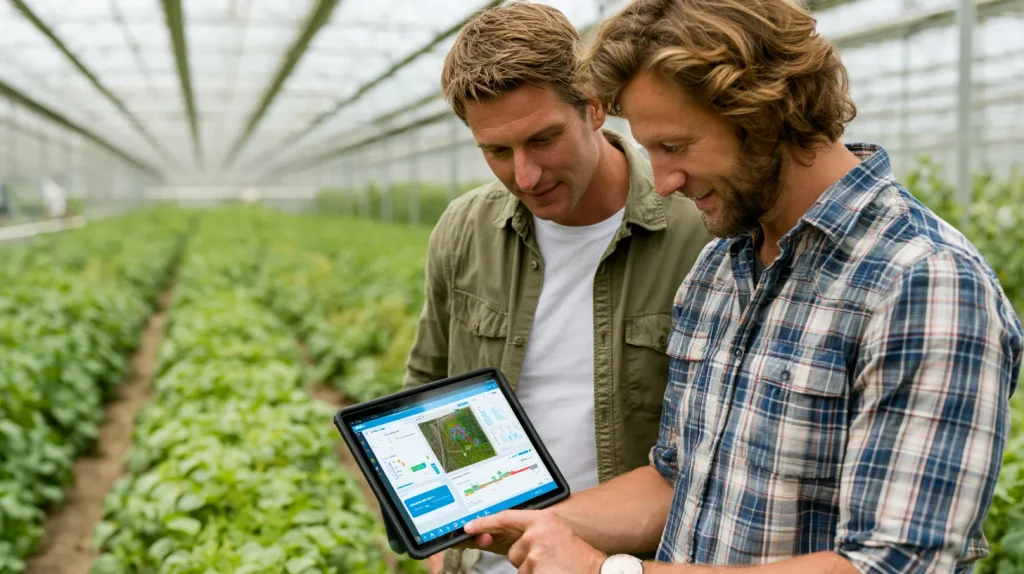
The clearest returns in modern AgriTech come from AI and IoT. Computer vision on drone and satellite imagery spots crop disease, pests and stress early; yield and demand models forecast harvests and guide planting; variable-rate AI applies inputs precisely to cut cost and runoff; and livestock monitoring flags health issues before they spread. IoT sensors and edge devices feed the real-time data those models need, even where the network is weak. These add cost, but they are where the measurable gains in yield, input savings and sustainability are. We cover the foundations in our guides to computer vision and machine learning for business.
Common mistakes
The expensive errors repeat. Underestimating data integration - satellite, sensor and machine formats rarely align cleanly - and watching the timeline slip. Designing for always-on connectivity when farms are offline half the time, so the app fails in the field. Buying a closed platform and then fighting its data lock-in. Bolting on computer vision without the labeled data to make it reliable. And building for one farm or crop when multi-farm, multi-crop growth is on the roadmap, then re-architecting under load.
How to decide
Start by naming the system you actually need - an FMS, a precision-ag platform, an IoT and irrigation layer, a drone-imagery tool or a livestock and traceability system - because that, plus your data-integration depth, sets the band more than anything else. If a standard process will do, an off-the-shelf platform gets you moving fast; if your agronomy, data or grower experience is the advantage, build the custom layer that makes it one, and design offline-first for the field. Most operators land on a hybrid and invest the custom budget where the differentiation is. If you are scoping an AgriTech build, our agriculture software development team can map the type, data and IoT integrations, cost and timeline with you, from a single farm app to a full precision-agriculture platform.
FAQ
Quick answers to common questions about custom software development, pricing, process and technology.
Type to filter questions and answers. Use Topic to narrow the list.
Showing all 8
No matches
Try a different keyword, change the topic or clear filters
-
A single custom module or MVP - a farm app, a monitoring dashboard or a grower marketplace MVP - costs roughly $50,000 to $150,000 over 3 to 6 months. A mid-size FMS or precision-ag platform with IoT, mapping and integrations runs $150,000 to $500,000 over 6 to 14 months. An enterprise platform with drone and satellite analytics, AI and multi-farm rollout reaches $500,000 to $2M and up over 12 to 24 months.
-
Buy off-the-shelf (John Deere Operations Center, Climate FieldView, Granular or regional FMS tools) when your processes are standard and speed matters - you start fast but fit your operation to their model and lock into their ecosystem and data. Build custom when your agronomy models, data assets or grower experience are the advantage, or you are an AgriTech vendor building a product to sell. Many run a hybrid: an off-the-shelf core with custom apps around it.
-
An FMS (farm management system) is the operational record and planning hub - fields, crops, tasks, inputs and costs. Precision agriculture goes deeper: it uses field data (maps, soil zones, imagery, yield) to make sub-field decisions and apply inputs exactly where needed. The FMS runs the farm; precision ag optimizes every acre with data.
-
A single module or MVP ships in 3 to 6 months, a mid-size FMS or precision-ag platform in 6 to 14 months and an enterprise platform with imagery and AI in 12 to 24 months or more. Harmonizing many data sources - satellite, sensor, weather, machine - and designing for patchy rural connectivity usually set the schedule more than the core application.
-
The usual set is IoT soil, weather and crop sensors, farm machinery and telematics (often over the ISOBUS standard), satellite and drone imagery, weather and climate data, GIS and mapping and the ERP, accounting or marketplace systems the business runs on. The hard part is harmonizing heterogeneous field data into one trustworthy picture, often with poor rural connectivity.
-
The clearest uses are computer vision on drone and satellite imagery (spotting crop disease, pests and stress early), yield and demand forecasting, variable-rate AI (applying inputs precisely to cut cost and runoff) and livestock monitoring. IoT sensors feed the real-time data these models need. AI is where the measurable gains in yield, input savings and sustainability are.
-
Variable-rate application (VRA) applies seed, fertilizer or water at different rates across a field from a prescription map, instead of one uniform rate - saving inputs and lifting yield. NDVI is a vegetation index from satellite or drone imagery that measures crop health and vigor across a field, often the data behind those prescriptions.
-
Design offline-first: the app stores and queues data locally and syncs when a connection returns, and edge devices process sensor data on-site rather than streaming everything to the cloud. Assuming always-on connectivity is one of the most common AgriTech mistakes, because farms are frequently offline.
Budget for offline-first from the start, since retrofitting it is expensive.
Agriculture software glossary 8
- Farm management system (FMS)
- The operational hub that records and plans farm activity - fields, crops, tasks, inputs, equipment, labor and costs. The backbone most farms start with.
- Precision agriculture
- Managing crops at field- and sub-field level using data - maps, soil zones and yield data - to apply seed, fertilizer and water exactly where needed instead of uniformly.
- Variable-rate application (VRA)
- Applying inputs like seed, fertilizer or water at different rates across a field based on a prescription map, cutting cost and runoff while lifting yield.
- NDVI / remote sensing
- NDVI (Normalized Difference Vegetation Index) and similar indices derived from satellite or drone imagery measure crop health and vigor across a field from above.
- IoT sensors
- Connected soil-moisture, weather and crop sensors that feed real-time field data to the software and can automate irrigation and inputs, even where rural networks are weak.
- ISOBUS
- The ISO 11783 standard that lets tractors, implements and farm machinery from different makers communicate, so software can read and control equipment in a unified way.
- Livestock monitoring
- Tracking animal health, feeding, location and behavior with sensors and software to catch issues early, improve welfare and lift productivity.
- Traceability
- Recording a product's journey from farm to fork to prove provenance and meet food-safety and export rules. Increasingly underpinned by blockchain or tamper-evident records.

I work with startup founders who need a dedicated software development team but don’t want to gamble on hiring, random outsourcing, or opaque delivery.
Most founders face the same problem sooner or later.
Early technical and team decisions lock the product into tech debt, slow delivery, missed milestones and constant re-hiring. By the time this becomes visible, fixing it is already expensive.As a CTO and software architect, I help founders design, build and run dedicated development teams that work as a true extension of the startup. Not as a black-box vendor.
My focus is on complex products where mistakes are costly:
- Web3 and blockchain platforms
- FinTech and regulated products
- High-load startup systems
- MVP → scale transitions
We don’t do body-shopping.
We don’t sell generic outsourcing.Instead, we help founders:
- build the right team structure from day one
- keep technical ownership and transparency
- scale delivery without losing control
- avoid vendor lock-in and hidden risks
Teams are aligned with the product roadmap, business goals and long-term architecture. Not just short-term velocity.