Manufacturing Software Development in 2026: Types, Cost and Build Guide
Manufacturing software development in 2026: MES, ERP, IIoT, digital twin and predictive maintenance types, build vs buy, costs and timelines.
 Updated
7 min read
230 views
Updated
7 min read
230 views
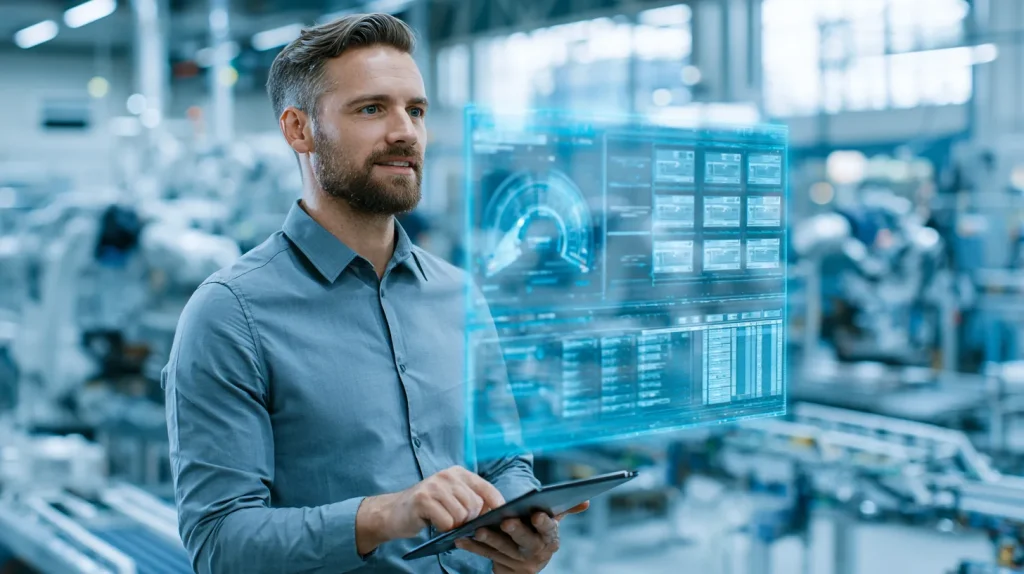
Key takeaways: manufacturing software development in 2026 5
The main system types, build vs buy and the real cost ranges by scope.
- Name the system first MES, manufacturing ERP, IIoT, digital twin or predictive maintenance - each is a different build.
- OT integration is the cost Connecting PLCs, SCADA and legacy machines is the biggest and most underestimated driver.
- Cost by scope $70K-$180K a module, $180K-$600K an MES, $600K-$2.5M and up a full Industry 4.0 platform.
- Build, buy or hybrid Off-the-shelf starts fast; custom wins when your process is the advantage. Most land on a hybrid.
- AI and IIoT pay off Predictive maintenance, vision quality and digital twins are where downtime and scrap savings are.
"Manufacturing software" runs from a single production dashboard to a full Industry 4.0 stack that links the factory floor, the ERP and a digital twin, so the cost and the build swing widely with what you are actually making. The job is to name the system you need - an MES, a manufacturing ERP, an IIoT layer, a predictive-maintenance tool - then decide whether to buy, customize or build it. This guide explains manufacturing software development in 2026: the main types, build versus buy, what drives the cost and the honest ranges, before you scope a project with a manufacturing software development partner.
In short: manufacturing software spans MES (manufacturing execution), manufacturing ERP, industrial IoT and SCADA, digital twins and predictive maintenance and quality. A single custom module or MVP - a production dashboard, an OEE monitor, a quality app - costs roughly $70,000 to $180,000 over 4 to 7 months. A mid-size MES or module suite with ERP and machine integration runs $180,000 to $600,000 over 8 to 14 months. A full Industry 4.0 platform with IIoT, a digital twin and multi-plant rollout reaches $600,000 to $2.5M and up over 14 to 30 months. Off-the-shelf suites from SAP, Siemens or Rockwell start fast but cost more to license and bend to your process; custom wins when your process or your data is the differentiator. Integrating operational technology (OT) on the plant floor is what makes manufacturing builds harder, and costlier, than typical business software.
What manufacturing software is, and its main types
Manufacturing software plans, runs, monitors and improves production. It is not one product but a family of systems, and most projects are one or two of them rather than all at once. The main types are manufacturing execution (running and tracking production on the floor), manufacturing ERP (planning materials, orders and finance), industrial IoT and SCADA (connecting and controlling machines), digital twins (a live virtual model of a line or plant), and predictive maintenance and quality (using sensor and vision data to prevent failures and defects). Naming which of these you need is the single most important scoping decision, because each is a different build with different plant-floor integration.
The core systems explained
MES (manufacturing execution system): runs and tracks production on the floor - work orders, scheduling, machine and labor status, traceability and OEE (overall equipment effectiveness). The system that sits between the ERP and the machines.
Manufacturing ERP: plans and manages materials, production orders, inventory, procurement and finance. The business backbone, often off-the-shelf, that the MES and floor systems feed.
Industrial IoT and SCADA: connects machines, PLCs and sensors to collect data and supervise control. The bridge between operational technology on the floor and the software layer above it.
Digital twin: a live virtual model of a machine, line or plant, fed by real-time data, used to simulate, monitor and optimize without touching the physical asset.
Predictive maintenance and quality: uses sensor and computer-vision data to predict equipment failures before they happen and catch defects on the line, cutting downtime and scrap.
Many of these same digital-twin and IIoT patterns show up upstream too, since teams building software for construction and building projects now lean on similar sensor data and equipment tracking to plan and monitor the sites that eventually house a production line.
Build, buy or customize
The first cost decision is build versus buy. Off-the-shelf suites - SAP, Siemens Opcenter, Rockwell, AVEVA - cover standard processes and start fast, but you pay heavy license fees and you bend your operation to fit the software, and customizing a big suite to a non-standard process can cost as much as a custom build. Custom software is the right call when your manufacturing process is a competitive advantage, when you need machine and OT integrations the suites do not support, or when per-seat or per-site pricing stops making sense at scale. Many manufacturers run a hybrid: an off-the-shelf ERP core with custom apps - a floor MES, an OEE dashboard, a predictive-maintenance model - built around it. The custom layer is usually where the process advantage and the value sit.
What drives manufacturing software cost
Within any type, the same factors move the number. Scope - one module versus a full MES or Industry 4.0 stack. OT integration - connecting PLCs, SCADA and legacy machines with mixed and proprietary protocols is the biggest and most underestimated driver. Real-time demands - floor monitoring, control and digital twins need event-driven, low-latency architecture. Hardware and edge - sensors, gateways and edge computing on the plant floor add device and connectivity work. Multi-plant and scale - more lines, sites, languages and regulations multiply the effort. And AI - predictive maintenance, vision quality and twin simulation add model, data and evaluation work on top of the application.
Manufacturing software cost and timeline in 2026
Ranges track scope and plant-floor integration depth more than anything else.
Single module / MVP: $70,000 to $180,000, 4 to 7 months. One focused system - a production or OEE dashboard, a quality app or a monitoring tool - with core machine and ERP integration.
Mid-size platform: $180,000 to $600,000, 8 to 14 months. A full MES or module suite with ERP, SCADA and machine integration, traceability, dashboards and reporting.
Enterprise Industry 4.0 platform: $600,000 to $2.5M and up, 14 to 30 months. MES plus IIoT, predictive maintenance and analytics, a digital twin and multi-plant, multi-region rollout.
On top of build cost, budget 15 to 20 percent of it per year for maintenance, plus edge and cloud infrastructure that scales with machines and data volume, and new integrations as equipment changes. For a wider view of lifetime cost, see our custom software TCO report.
Integrations that matter
Manufacturing software lives or dies on its integrations, because it has to reach both the business systems and the machines. The usual set is the ERP for materials and orders, PLCs, SCADA and machine controllers on the floor (over protocols like OPC UA, Modbus and MQTT), IIoT sensors and gateways for condition data, a PLM system for product and BOM data, and supply chain and logistics for inbound and outbound flow. The plant-floor OT side is the hard part - protocols are mixed, some equipment is decades old, and safety and uptime cannot be risked - which is why OT integration is the largest share of most manufacturing budgets. We cover the downstream flow in our guide to logistics software development, and the back office in our ERP development guide.
AI and IoT in manufacturing in 2026
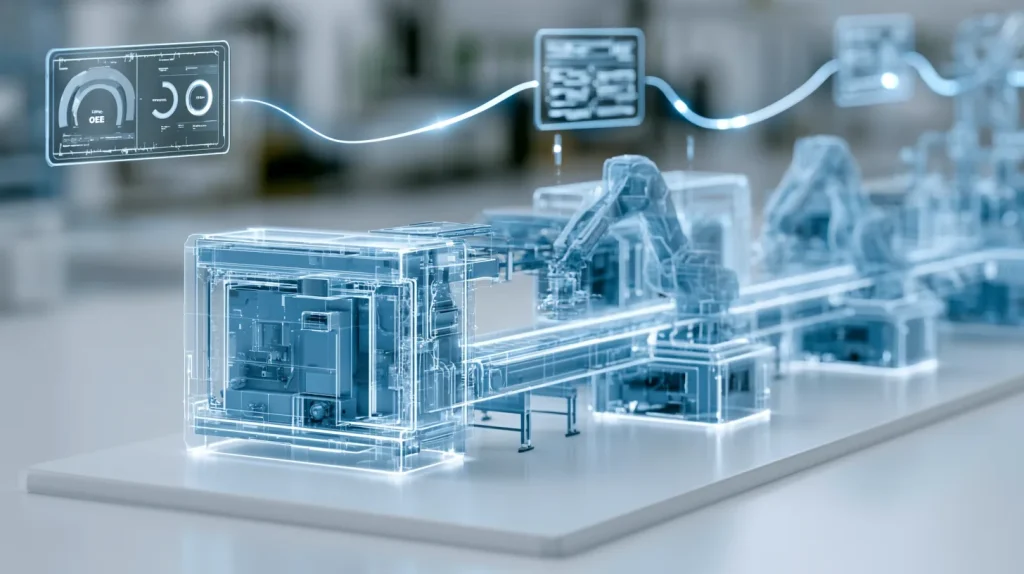
The clearest returns in modern manufacturing - the core of Industry 4.0 - come from AI and IIoT. Predictive maintenance uses sensor data to fix machines before they fail, cutting unplanned downtime; computer-vision quality inspection catches defects faster and more consistently than manual checks; and digital twins simulate changes before they hit the floor. IIoT - sensors, edge devices and connectivity - feeds the real-time data those models need. These add cost, but they are where the measurable savings in downtime, scrap and energy are, which is why they increasingly anchor enterprise builds. We cover the economics in our guides to machine learning for business and IoT development.
Common mistakes
The expensive errors repeat. Underestimating OT integration - mixed protocols and legacy machines - and watching the timeline slip. Buying a heavyweight suite and customizing it so far it costs more than a custom build would have. Treating real-time monitoring and digital twins as features to add later, when they need low-latency, event-driven architecture from the start. Ignoring the operational reality of plant-floor uptime, safety and patchy connectivity. And building for one line or one plant when multi-plant rollout is on the roadmap, then re-architecting under load.
How to decide
Start by naming the system you actually need - an MES, a manufacturing ERP, an IIoT layer, a digital twin or a predictive-maintenance tool - because that, plus your OT integration depth, sets the band more than anything else. If a standard process will do, an off-the-shelf core gets you moving fast; if your process is the advantage, build the custom layer that makes it one. Most manufacturers land on a hybrid and invest the custom budget where the differentiation is. If you are scoping a manufacturing build, our manufacturing software development team can map the type, OT and machine integrations, cost and timeline with you, from a single floor dashboard to a full Industry 4.0 platform.
FAQ
Quick answers to common questions about custom software development, pricing, process and technology.
Type to filter questions and answers. Use Topic to narrow the list.
Showing all 8
No matches
Try a different keyword, change the topic or clear filters
-
A single custom module or MVP - a production or OEE dashboard, a quality app or a monitoring tool - costs roughly $70,000 to $180,000 over 4 to 7 months. A mid-size MES or module suite with ERP, SCADA and machine integration runs $180,000 to $600,000 over 8 to 14 months. A full Industry 4.0 platform with IIoT, a digital twin and multi-plant rollout reaches $600,000 to $2.5M and up over 14 to 30 months.
-
Buy off-the-shelf (SAP, Siemens Opcenter, Rockwell, AVEVA) when your processes are standard and speed matters - you start fast but pay heavy license fees and bend your operation to the software. Build custom when your manufacturing process is a competitive advantage or the suites cannot support your machine and OT integrations. Many manufacturers run a hybrid: an off-the-shelf ERP core with custom apps around it, investing the custom budget where the process advantage is.
-
An ERP plans the business - materials, orders, inventory and finance - at a high level. An MES (manufacturing execution system) runs the actual production on the floor - work orders, machine status, traceability and OEE - in real time. The ERP says what to make and when; the MES makes it happen and reports back. Most manufacturers run both and integrate them.
-
A single module or MVP ships in 4 to 7 months, a mid-size MES or module suite in 8 to 14 months and a full Industry 4.0 platform in 14 to 30 months or more. Operational-technology integration - connecting PLCs, SCADA and legacy machines - and real-time or digital-twin features usually set the schedule more than the core application.
-
The usual set is the ERP for materials and orders, PLCs, SCADA and machine controllers on the floor (over protocols like OPC UA, Modbus and MQTT), IIoT sensors and gateways for condition data, a PLM system for product and BOM data and supply chain and logistics for inbound and outbound flow. The plant-floor OT side is the hard part - mixed protocols, old equipment and uptime that cannot be risked - and it is the largest share of most budgets.
-
The clearest uses are predictive maintenance (fixing machines before they fail to cut downtime), computer-vision quality inspection (catching defects faster than manual checks) and digital-twin simulation (testing changes before they hit the floor). IIoT sensors and edge devices feed the real-time data these models need. AI adds cost but is where the measurable savings in downtime, scrap and energy are.
-
Industry 4.0 is the connected, data-driven factory - IIoT, real-time data, AI and automation working together. A digital twin is one of its core tools: a live virtual model of a machine, line or plant, fed by real sensor data, used to monitor, simulate and optimize without touching the physical asset.
-
Budget 15 to 20 percent of the build cost per year for maintenance, plus edge and cloud infrastructure that scales with machines and data volume and new integrations as equipment changes. Off-the-shelf suites add per-seat or per-site license fees on top, which is part of why custom can win at scale.
Manufacturing software glossary 8
- MES (manufacturing execution system)
- Software that runs and tracks production on the floor - work orders, scheduling, machine and labor status, traceability and OEE. It sits between the ERP and the machines.
- Manufacturing ERP
- The system that plans and manages materials, production orders, inventory, procurement and finance. The business backbone, often off-the-shelf, that the MES and floor systems feed.
- IIoT (Industrial Internet of Things)
- Sensors, edge devices and connectivity that link machines and equipment to the software layer, feeding the real-time data that monitoring, predictive maintenance and digital twins need.
- SCADA
- Supervisory Control and Data Acquisition - the systems that monitor and control industrial machinery and processes on the plant floor, a key integration point for any manufacturing build.
- Digital twin
- A live virtual model of a machine, line or plant fed by real-time data, used to simulate, monitor and optimize changes without touching the physical asset.
- Predictive maintenance
- Using sensor data and AI to predict equipment failures before they happen, so machines are serviced just in time, cutting unplanned downtime and scrap.
- OT (operational technology)
- The hardware and software that monitors and controls physical equipment on the plant floor - PLCs, SCADA, machines. Integrating OT with IT systems is the hardest part of manufacturing software.
- PLM (product lifecycle management)
- Software that manages a product from design through manufacturing and service, holding the bill of materials and engineering data that production systems depend on.

I work with startup founders who need a dedicated software development team but don’t want to gamble on hiring, random outsourcing, or opaque delivery.
Most founders face the same problem sooner or later.
Early technical and team decisions lock the product into tech debt, slow delivery, missed milestones and constant re-hiring. By the time this becomes visible, fixing it is already expensive.As a CTO and software architect, I help founders design, build and run dedicated development teams that work as a true extension of the startup. Not as a black-box vendor.
My focus is on complex products where mistakes are costly:
- Web3 and blockchain platforms
- FinTech and regulated products
- High-load startup systems
- MVP → scale transitions
We don’t do body-shopping.
We don’t sell generic outsourcing.Instead, we help founders:
- build the right team structure from day one
- keep technical ownership and transparency
- scale delivery without losing control
- avoid vendor lock-in and hidden risks
Teams are aligned with the product roadmap, business goals and long-term architecture. Not just short-term velocity.