Skip to content

Reviewed by Dr. Dmytro Nasyrov, Founder and CTO • Last updated April 24, 2026

Blockchain Services

  • 30+ blockchain projects
  • 7+ years in Web3
  • 90+ Clutch reviews

Your business results matter

Achieve them with minimized risk through our bespoke innovation capabilities

Your contact details
Please enter your name
Please enter a valid email address
Please enter your message
* required

We typically reply within 1 business day

Reviewed and updated
Last reviewed by Dmytro Nasyrov, Founder and CTO. Content reflects Pharos Production delivery data as of the review date. Editorial policy.

What is blockchain development?

Blockchain development is the engineering of software that runs on distributed ledgers with trustless execution and cryptographic verification. It covers smart contracts (Solidity, Vyper, Rust), decentralized applications with wallet integration, token standards (ERC-20, ERC-721, ERC-1155, ERC-3643), DeFi primitives (lending, AMMs, yield, stablecoins), NFT marketplaces, bridges, oracles and the supporting infrastructure (node operations, indexers, subgraphs, RPC providers). Pharos has shipped 100+ contracts to mainnet since 2018 with zero critical vulnerabilities reported.
Authoritative citations 12 sources
  1. Ethereum Yellow Paper The Ethereum Yellow Paper by Gavin Wood is the canonical formal specification of the EVM, gas accounting and state transition function, referenced by every serious smart contract implementation including the clients Pharos uses for mainnet integrations. ethereum.github.io
  2. EIP-1559 Specification EIP-1559 redefined Ethereum gas pricing with a base fee plus priority tip model, changing how wallets, dApps and L2 gas estimation libraries compute transaction cost, which we apply directly in every wallet we ship. eips.ethereum.org
  3. Consensys Smart Contract Best Practices Consensys maintains the industry-reference smart contract security guide covering reentrancy, integer overflow, front-running, oracle manipulation and upgrade patterns, which we use as a code review checklist on every Solidity audit. consensys.github.io
  4. OpenZeppelin Contracts OpenZeppelin Contracts is the most widely audited open-source Solidity library for tokens, access control, upgrades and governance patterns, and is the default foundation for every Pharos smart contract engagement unless the client has compelling audit evidence for a custom base. docs.openzeppelin.com
  5. Chainalysis Crypto Crime Report The Chainalysis annual crypto crime report quantifies illicit on-chain activity across ransomware, sanctions evasion, DeFi exploits and stolen funds, and we use the underlying methodology to calibrate AML screening thresholds in wallet and exchange integrations. chainalysis.com
  6. Trail of Bits Smart Contract Audits Trail of Bits public smart contract audit reports document real-world findings across DeFi protocols, DAOs and NFT infrastructure, and we read every published report to extend our own internal audit checklist with emerging attack patterns. github.com
  7. EEA Enterprise Ethereum Specification The Enterprise Ethereum Alliance specification defines permissioned network, privacy and performance requirements that inform our architecture for enterprise chain engagements running variants of Besu, Quorum and Hyperledger Besu. entethalliance.org
  8. Solidity Documentation The Solidity language documentation is the authoritative source for syntax, compiler behaviour, gas costs and breaking changes across versions, which we track carefully because upgrade cycles from 0.8.x to 0.9.x affect every contract in production. docs.soliditylang.org
  9. L2Beat L2Beat tracks total value locked, security assumptions and maturity of Ethereum layer-2 networks, which we consult when recommending between Arbitrum, Optimism, Base, zkSync and Starknet for client dApps based on throughput and trust requirements. l2beat.com
  10. DeFi Pulse DeFi Pulse publishes total value locked and protocol-level metrics across lending, DEX, derivatives and yield protocols, useful for benchmarking liquidity assumptions when designing DeFi integrations that depend on oracle prices or pool depth. defipulse.com
  11. Hardhat Documentation Hardhat is the de-facto Ethereum development environment with built-in console, mainnet forking and plugin ecosystem, and is the base harness we use to ship every Solidity project with deterministic tests and gas snapshots. hardhat.org
  12. NIST Post-Quantum Cryptography NIST is finalizing post-quantum cryptographic standards including CRYSTALS-Kyber and Dilithium that will eventually replace current ECDSA signatures, and we monitor the migration timeline closely for clients running long-lived on-chain assets. csrc.nist.gov
What we do not do:
  • Token launches without legal counsel on securities classification
  • Off-chain workflows where a centralized database would solve the problem faster and cheaper
  • Consumer products where wallet UX friction will kill adoption
  • High-frequency micro-transactions on Ethereum mainnet without an L2 architecture

Custom blockchain build vs fork / template: which is better?

Custom-built blockchain systems give you exact business logic, defensible security posture and full ownership, while forked protocols (Uniswap V3 fork, Compound fork) ship faster but inherit the source code attack surface. According to a 2024 Chainalysis report, 78% of DeFi exploits in 2023 targeted forked or template-based contracts where the team had not adapted security to their specific economic surface.

Factor Custom blockchain build Forked / template protocol
Business logic fit Exact fit; tuned to your economic model and edge cases Generic; may force economic workarounds
Security posture Threat-modeled to your attack surface; externally audited Inherits the source code AND the source attack surface
Gas efficiency Storage layout and calldata optimized for your hot paths Generic optimization; gas costs compound
Upgradability Proxy patterns + timelock + multisig designed in from day one Often immutable or tied to source upgrade roadmap
Token economics Custom mint/burn/yield curves with formal verification of invariants Pre-set economic models; cannot be tuned
Multi-chain Chain abstraction layer; new chains in 1-2 weeks Locked to vendor-supported chains
Cost $40K-$400K build cost + audit $5K-$20K for a fork + audit (still required)
Best fit DeFi protocols, RWA, custom economics, anything with material TVL Hackathon prototypes, low-stakes experiments, learning projects

Blockchain development at Pharos Production at a glance

  • Contracts shipped: 100+ smart contracts deployed to mainnet across 7+ EVM chains and Solana since 2018
  • Audit record: 100% of Pharos contracts pass external audit on first pass; zero critical vulnerabilities reported
  • Stack: Solidity, Vyper, Rust (Solana, Stylus), Foundry, Hardhat, Slither, Mythril, Echidna, OpenZeppelin
  • Chains: Ethereum, Polygon, Arbitrum, Optimism, Base, BSC, Avalanche, Solana, TON
  • Pricing: dApp MVP from $40,000-$120,000; full DeFi protocol $120,000-$400,000+; infrastructure retainers from $8,000/month
  • Timeline: Discovery 2-4 weeks; dApp MVP 8-14 weeks; production protocol 4-8 months with external audit cycle
  • Compliance: ISO 27001, SOC 2, KYC/AML hooks for token launches with legal review, multi-sig governance
  • Honest scope: We decline token launches without legal counsel and consumer products where wallet UX kills adoption

Our Software Development Expertise

Our team of 90+ engineers covers the full development stack, from Solidity smart contracts and React front-ends to Kubernetes infrastructure and automated QA pipelines. Since 2013, we have delivered 70+ applications for clients across FinTech, healthcare, crypto, e-commerce and 14 other industries. Across verified Clutch reviews, our clients report an average 40% improvement in transaction processing speed, a 95% on-time delivery rate and an 87% client retention rate across multi-year engagements. Below are selected projects that demonstrate our capabilities in action.

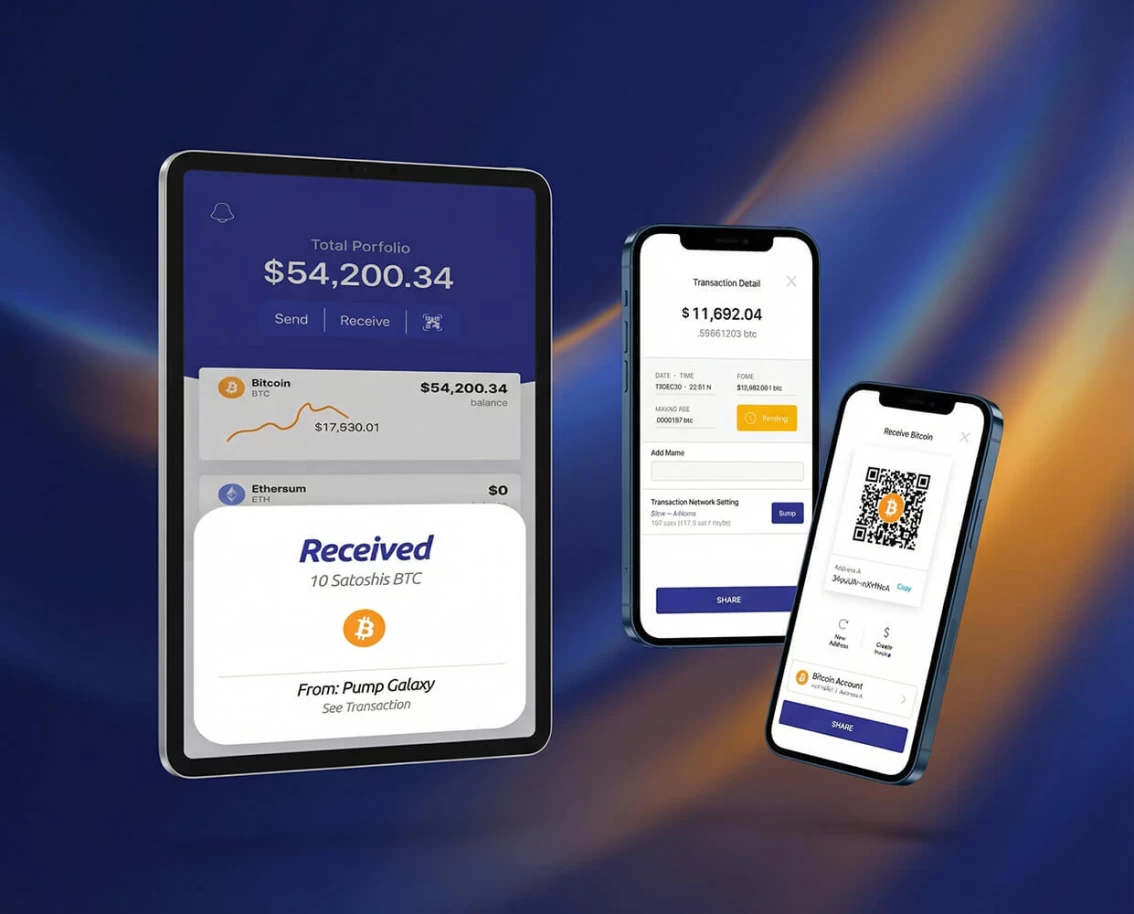
  • PumpTap crypto wallet multi-chain asset dashboard
    PumpTap Crypto Wallet - application interface, screen 2
    PumpTap Crypto Wallet - application interface, screen 3
    Web3 & Blockchain

    PumpTap Crypto Wallet

    Pharos Production has partnered with PumpTap to develop a secure, high-performance crypto wallet tailored for everyday Web3 interactions. PumpTap lets users store, send and manage digital assets across multiple blockchains through a simple, intuitive interface. Built on a scalable, event-driven architecture, the wallet delivers real-time transaction updates, robust security and seamless integration with decentralized applications.

  • Ludo soulbound NFT reputation profile showing on-chain trust metrics
    Ludo reputation scoring interface with cross-chain blockchain data visualization
    Ludo Web3 reputation platform dashboard showing wallet trust scores and activity feed
    Web3 & Blockchain

    Ludo. Reputation platform of Web3

    Pharos Production partnered with Ludo to build a global cross-chain reputation system that makes trust transparent and portable across the Web3 ecosystem. Using AWS, Kubernetes, Istio, Kafka, Flink, Cassandra, Pinot and Solr, the platform processes blockchain data in real time to generate soulbound NFT-based reputation scores. With web, browser and Telegram interfaces, Ludo empowers users, curators and builders to identify trustworthy projects, integrate reputation APIs and strengthen community engagement. The result is a scalable, real-time trust layer that has been driving adoption in Web3 since 2021.

About Founder and CTO

Dmytro Nasyrov

Dmytro Nasyrov

Founder and CTO Pharos Production

Ask the founder a question

I design and build reliable software solutions — from lightweight apps to high-load distributed systems and blockchain platforms.

PhD in Artificial Intelligence, MSc in Computer Science (with honors), MSc in Electronics & Precision Mechanics.

  • 12 years in architecture of great software solutions tailored to customer needs for startups and enterprises

  • 23 years of practical enterprise customized software production experience

  • Lecturer at the National Kyiv Polytechnic University

  • Doctor of Philosophy in Artificial Intelligence

  • Master’s degree in Computer Science, completed with excellence

  • Master’s degree in Electronics and precision mechanics engineering

Pharos Production - Describe your idea & get a quote in 48h! Get an estimate for the costs, timeline & the team layout needed for your project Get a project estimate.

Blockchain delivery with security first

Blockchain projects follow Pharos Verified Delivery with security-first additions: discovery includes threat modeling and economic attack analysis; build includes Slither/Mythril/Foundry fuzz in CI plus manual review; production readiness requires external audit coordination and a deployment runbook with rollback plan.

Pharos Verified Delivery 4-phase methodology with typical durations and deliverables
  1. Phase 01 / 04

    Paid Discovery

    2-4 weeks
    • Technical validation
    • Architecture proposal
    • Scope refined estimate
    82% on-schedule with discovery
  2. Phase 02 / 04

    Iterative Build

    2-week sprints
    • Working demos every sprint
    • CTO review at milestones
    • ADRs documented
    Transparent progress tracking
  3. Phase 03 / 04

    Production Readiness

    • Monitoring and alerting
    • Security audit Pen test
    • Runbooks and rollback
    ISO 27001 compliant
  4. Phase 04 / 04

    Support

    Ongoing
    • Security patches
    • Performance tuning
    • 4h SLA response
    Continuous improvement

Pharos Verified Delivery applied to 70+ production applications since 2013

Blockchain projects shipped to mainnet

Three blockchain engagements with the chain architecture and oracle decisions that made them hold up under real traffic.

Multi-chain expansion Q4 2024 · DeFi protocol, global
Before

Single-chain protocol on Ethereum mainnet only. New chain integrations took 8-12 weeks each. TVL capped at $45M.

After

Chain abstraction layer supporting 7+ EVM chains plus Solana. New chain integration down to 1-2 weeks. TVL grew to $180M across chains in 6 months.

The abstraction layer normalizes RPC calls, fee estimation and transaction signing. New chain support is now a config file plus a chain-specific adapter, not a rewrite of the core protocol.

Oracle redesign Q1 2025 · Lending protocol, EU
Before

Chainlink price feeds alone. Oracle manipulation attack during a thin-liquidity event drained $2.1M in 4 minutes.

After

Layered oracle design with time-weighted average prices (TWAP), cross-oracle consensus and circuit breakers. Zero oracle-based exploits in 12 months post-redeployment. Liquidation accuracy improved across all pairs.

We replaced the single-source oracle with a 3-of-5 consensus across Chainlink, Pyth and a protocol-specific TWAP. If consensus breaks, liquidations pause and the protocol enters read-only mode until governance intervenes.

Node infrastructure Q3 2024 · Crypto exchange, APAC
Before

Managed RPC providers (Infura, Alchemy) cost $18,000/month and rate-limited during peak trading. Transaction confirmation latency 4-12 seconds.

After

Self-hosted archive nodes on bare-metal infrastructure with geo-distributed load balancers. Costs down to $4,200/month. Confirmation latency under 800ms. Zero rate-limit incidents.

We run a mix of Geth, Erigon and Reth based on query pattern — archive reads go to Erigon for storage efficiency, hot path queries go to Reth for speed, fallback is Geth for compatibility.

Client names anonymized under NDA. Full case studies at /cases/.

When blockchain development is not the answer

We decline roughly 30% of RFPs we receive. Forcing a bad fit costs both sides 3-6 months and damages outcomes. Here is how we think about scope:

Projects we decline
  • Problems solvable by a centralized database 10x faster and cheaper
  • Consumer products where wallet UX friction will kill adoption
  • Enterprise workflows where Hyperledger or APIs are simpler than a public chain
  • Token launches without legal counsel on securities classification
  • High-frequency micro-transactions on Ethereum mainnet without an L2 architecture
We say no to bad blockchain fits

Not every problem benefits from decentralization. We start every blockchain engagement by asking "would a regular database solve this?" If yes, we say so. We have declined token launch projects where the product clearly did not need blockchain - because forcing it costs the client months and us our reputation.

Before you pick a blockchain partner

How to Choose a Blockchain Development Company →

Founder-grade evaluation guide covering security expertise, multi-chain experience, regulatory awareness and red flags to watch for when picking a blockchain partner.

Pharos blockchain portfolio

Pharos blockchain delivery portfolio observations, 2017-2026

Ranges we consistently see across 25+ smart contract engagements.

  • 0.8-2.1 high-severity findings per 1000 LoC on first-pass audits of our contracts; 0-0.3 on post-remediation audits before mainnet deploy[6].

  • 15-38% gas reduction typical on optimization passes via storage packing, custom errors and assembly for hot paths. Higher savings on older Solidity versions[11].

  • L2 rollup transaction cost runs 20-100x cheaper than Ethereum mainnet on equivalent operations. Migration to L2 pays back within 2-4 months for most dApps[9].

  • 8-16 weeks for production smart contract system including audit, upgrade pattern and oracle integration. Cross-chain adds 4-8 weeks.

  • Under 8% of contracts shipped since 2022 required post-deploy critical patches; zero required emergency migration when upgrade pattern built in from day one[7].

Blockchain development outlook 2026-2027

Three shifts are reshaping blockchain engineering and smart contract delivery.

  • Ethereum L2 rollups (Arbitrum, Optimism, Base, zkSync) now carry 60-80% of active dApp traffic versus L1. L1-only dApps see user migration cliff by 2026[9].

  • ERC-4337 account abstraction enables gas sponsorship, social recovery and batched ops. Consumer dApps without AA see onboarding drop-off 2-3x higher than AA-enabled peers[8].

  • NIST-finalized post-quantum standards (CRYSTALS-Kyber, Dilithium) enter enterprise Ethereum pilots by 2027. Long-lived contracts holding assets require upgrade paths[12].

Our four-dimension smart contract evaluation template

Every smart contract system we ship runs against the same four-dimension readiness evaluation before mainnet deploy.

Production post-mortem

When the signature check missed a malleability edge case

A permit2-style signature check in a DEX router deployed in May 2025 validated signer but did not canonicalize signature format. An attacker crafted a malleable variant of an unused approval signature, re-ordered the "s" component and replayed the approval on a different chain. $42k in tokens redirected before we caught it via on-chain monitoring 4 hours later. Root cause: ECDSA "s" value not constrained to lower half of curve order.

Signature canonicalization (lower-half "s" enforcement) now mandatory on every signature-checking contract. ECDSA replay testing added to audit checklist. Cross-chain signature domain separation (EIP-712 chainId binding) verified in integration tests.

Smart contract and regulatory boundaries
Pharos Production builds blockchain software and smart contracts. We do not provide investment advice, securities classification or money transmitter services. Token regulatory compliance is the client legal responsibility. Smart contracts are deployed at client direction after security audit.

Reviews

Independent reviews from Clutch, GoodFirms and Google - verified client feedback on our software projects

Based on 11 verified client reviews

5 out of 5 stars
Healthcare

Pharos Production delivered a secure and scalable healthcare platform that integrated seamlessly with our existing clinical systems and workflows. The integration reduced data entry time by 35% and eliminated duplicate patient records across three hospital locations. Their team demonstrated strong domain expertise, clear communication and consistent delivery throughout the project lifecycle.

Michael Reynolds
5 out of 5 stars
Information Technology

Delivered logistics solution transforming operations with deep domain understanding.

Matthew Agar
5 out of 5 stars
Web3 & Blockchain

Structured development process with strong project management and quality delivery.

Gary Prioste
5 out of 5 stars
Software Development

Delivered retail app with strong UX, reliability, and positive user feedback.

Ramy Badie
5 out of 5 stars
AI

Strong domain expertise and agile delivery.

Joshua Hernandez
5 out of 5 stars
Web3 & Blockchain

Delivered blockchain-based content protection system with seamless performance.

Claire Quirk
5 out of 5 stars
Web3 & Blockchain

Performed deep audit of DEX smart contracts, improving performance and ensuring compliance.

Dennis Qian
5 out of 5 stars
Web3 & Blockchain

Built blockchain credential verification system improving fraud reduction and verification speed.

Gulshan Baig
5 out of 5 stars
Web3 & Blockchain

Delivered secure crypto wallet with strong usability and proactive issue handling.

Anonymous
5 out of 5 stars
Software Development

Provided scalable architecture design with workshops and implementation guidance.

CEO at EdgeTier
5 out of 5 stars
AI

AI and automation significantly improved operations.

Steven Charles

Platforms We Work With

Trusted by Coinbase, Consensys, Core Scientific, MicroStrategy, Gate.io and 10+ more Web3 and enterprise platforms

16+ partners

Our 16 technology partners include:

  • Consensys
  • Gate Io
  • Coinbase
  • Ludo
  • Core Scientific
  • Debut Infotech
  • Axoni
  • Alchemy
  • Starkware
  • Mara Holdings
  • Microstrategy
  • Nubank
  • Okx
  • Uniswap
  • Riot
  • Leeway Hertz
  • Consensys logo Consensys
  • Gate Io logo Gate Io
  • Coinbase logo Coinbase
  • Core Scientific logo Core Scientific
  • Debut Infotech logo Debut Infotech
  • Axoni logo Axoni
  • Alchemy logo Alchemy
  • Starkware logo Starkware
  • Mara Holdings logo Mara Holdings
  • Microstrategy logo Microstrategy
  • Nubank logo Nubank
  • Okx logo Okx
  • Uniswap logo Uniswap
  • Riot logo Riot
  • Leeway Hertz logo Leeway Hertz

Pharos Production - Ready to realize your vision? Embrace outsourcing and remote hiring with our skilled software developers! Build Your Software Today.

Dmytro Nasyrov - Founder and CTO of Pharos Production

Reviewed by Dmytro Nasyrov

Founder and CTO

23+ years in custom software development. Led 70+ projects across FinTech, healthcare, Web3 and enterprise. ISO 27001 certified team.

Choose your cooperation model

Launch
Smart contract launch

Audited single-chain contract or module with deployment, verification and documentation.

$21,000 - $45,000
Popular choice
Protocol
Protocol build

Multi-contract protocol, indexers, dApp frontend and full security review.

$40,000 - $85,000
Ecosystem
Full ecosystem

Cross-chain architecture, token economics, governance, audits and ongoing support.

$85,000 - $190,000

Prices vary based on project scope, complexity, timeline and requirements. Contact us for a personalized estimate.

Or select the appropriate interaction model

Request staff augmentation

Need extra hands on your software project? Our developers can jump in at any stage – from architecture to auditing – and integrate seamlessly with your team to fill any technical gaps.

Outsource your project

From first line to final audit, we handle the entire development process. We will deliver secure, production-ready software, while you can focus on your business.

Comparison of engagement models at Pharos Production
Model Best for Team setup Budget range
Staff Augmentation Existing teams needing extra engineers at any project stage 1-2 weeks From $5,000/month
Project Outsourcing Full-cycle development from idea to production launch 1-2 weeks $10,000-$80,000+
37+ technologies

Technologies, tools and frameworks we use

Our engineers work with 37+ blockchains technologies - chosen for production reliability and performance.

Blockchains

Private and Public Blockchains 33

Ethereum
Ethereum
TON
TON
Corda
Corda
Tron
Tron
Hedera
Hedera
Stellar
Stellar
Consensys GoQuorum
Consensys GoQuorum
Solana
Solana
Arbitrum
Arbitrum
Binance Smart Chain (BSC)
Sei
Sei
Celo
Celo
Hyperledger
Hyperledger
MultiversX
MultiversX
IOTA
IOTA
Polkadot
Polkadot
Aptos
Aptos
Neo
Neo
Flow
Flow
Algorand
Algorand
Avalanche
Avalanche
EOS
EOS
Optimism
Optimism
Polygon
Polygon
Cosmos
Cosmos
Sui
Sui
Tezos
Tezos
Ontology
Ontology
Fantom
Fantom
NEAR Protocol
NEAR Protocol
VeChain
VeChain
Base
Base
IPFS
IPFS

Cloud Blockchain Solutions 4

Amazon Managed Blockchain
Amazon QLDB
Amazon QLDB
IBM Blockchain
IBM Blockchain
Oracle Blockchain
Oracle Blockchain
Trusted & Certified

Partnerships & Awards

Recognized on Clutch, GoodFirms and The Manifest for software engineering excellence

  • Partner1
  • Partner2
  • Partner3
  • Partner4
  • Partner5
20+ industry awards

Pharos Production - 70+ applications delivered over 13 years. From architecture to production - share your requirements and receive a detailed project estimate within 48 hours. Get a project estimate.
An approach to the development cycle

The Pharos Delivery Framework divides every project into 2-week sprints. After each sprint there is a retrospective of the work done, planning for the next sprint, a report of the work done and a plan for the next sprint. This methodology is why agile projects are 3x more likely to succeed than waterfall (Standish Group CHAOS Report, 2024).
  1. Team Assembly

    Our company starts and assembles an entire project specialists with the perfect blend of skills and experience to start the work.

  2. MVP

    We’ll design, build, and launch your MVP, ensuring it meets the core requirements of your software solution.

  3. Production

    We’ll create a complete software solution that is custom-made to meet your exact specifications.

  4. Ongoing

    Continuous Support

    Our company will be right there with you, keeping your software solution running smoothly, fixing issues, and rolling out updates.

Frequently asked questions about Blockchain Services development

Last updated:

  • Copy link Copies a direct link to this answer to your clipboard.

    A dApp MVP (smart contracts + frontend + wallet integration) typically takes 8-14 weeks: 2-3 weeks discovery + threat model, 5-8 weeks build with Slither/Mythril/Foundry in CI, 2-4 weeks external audit coordination and remediation. Production DeFi protocols with formal verification run 4-8 months.

    Infrastructure projects (node operations, indexers, bridges) run 3-6 months.
  • Copy link Copies a direct link to this answer to your clipboard.

    Depends on your users, gas budget and tooling needs. Ethereum mainnet for the deepest liquidity and most mature tooling.
    L2s (Arbitrum, Optimism, Base) for lower gas at Ethereum-equivalent security. Polygon/BSC/Avalanche for cost-sensitive retail dApps. Solana for high-frequency trading and payments. TON for Telegram-embedded mini apps. We do not chain-shop - we pick the chain that fits your workload.

  • Copy link Copies a direct link to this answer to your clipboard.

    Every Pharos blockchain project includes an internal pre-audit pipeline: Slither and Mythril static analysis on every pull request, Foundry invariant fuzzing on every release branch, Echidna property-based testing on financial primitives, and manual review against the OWASP smart contract top-10. External audits by Trail of Bits, Consensys Diligence or OpenZeppelin are coordinated before mainnet launch.

    100% of Pharos contracts have passed external audit on first pass since 2018.

  • Copy link Copies a direct link to this answer to your clipboard.

    We build the smart contracts, deployment tooling and frontend for token launches. We do NOT provide securities-law advice; clients must engage qualified legal counsel on token classification (Howey test, MiCA, state-level rules) before mainnet launch.

    We integrate KYC/AML providers (Sumsub, Onfido, Chainalysis) when the launch requires it, and design vesting/lockup contracts that match the legal opinion.

  • Copy link Copies a direct link to this answer to your clipboard.

    Yes. We operate self-hosted archive nodes (Geth, Erigon, Reth for EVM; custom for Solana), geo-distributed RPC endpoints, indexers (The Graph subgraphs, custom indexers), and monitoring.

    Self-hosted infrastructure typically costs 25-40% of managed-RPC-provider pricing at scale and eliminates rate-limit incidents during peak load. Our smallest infrastructure engagement starts at $4,000/month.


  • Copy link Copies a direct link to this answer to your clipboard.

    Layered approach: storage layout optimization (slot packing, immutable for unchanging values), calldata compression, view-only state mirroring, batch operations where applicable, and selective L2 deployment for high-frequency paths. Real example: a lending protocol went from $45-$120 per transaction on Ethereum mainnet to $15-$40 after optimization, with daily active users growing 4x.

  • Copy link Copies a direct link to this answer to your clipboard.

    Yes. Solana via Anchor + Rust for high-frequency trading and payments.

    Stellar for cross-border payments and tokenized assets. TON for Telegram mini-apps. Non-EVM chains require different security tooling (Anchor fuzz testing for Solana, Horizon for Stellar) but the Pharos Verified Delivery methodology is the same.

  • Copy link Copies a direct link to this answer to your clipboard.

    We decline when a centralized database would solve the problem faster and cheaper, when consumer UX cannot tolerate wallet friction, when token launches lack legal counsel, or when smart contracts handle regulated activities without a compliance plan. We walk away from 30%+ of incoming blockchain RFPs for these reasons - forcing a bad fit costs both sides 3-6 months.

The Pharos takeaway on blockchain development

Blockchain rewards teams that treat smart contracts as immutable infrastructure with audit, upgrade planning and oracle integrity as first-class engineering concerns[1]. L2 routing, account abstraction and post-quantum planning are the three areas that separate blockchain systems built for 2026 from systems still defending L1 mainnet-only assumptions.

Book a 30-minute blockchain readiness call
Dmytro Nasyrov, Founder and CTO at Pharos Production
Dmytro Nasyrov Founder & CTO Let’s work together!

Your business results matter

Achieve them with minimized risk through our bespoke innovation capabilities

Your contact details
Please enter your name
Please enter a valid email address
Please enter your message
* required

We typically reply within 1 business day

What happens next?

  1. Contact us

    Contact us today to discuss your project. We’re ready to review your request promptly and guide you on the best next steps for collaboration

    Same day
  2. NDA

    We’re committed to keeping your information confidential, so we’ll sign a Non-Disclosure Agreement

    1 day
  3. Plan the Goals

    After we chat about your goals and needs, we’ll craft a comprehensive proposal detailing the project scope, team, timeline and budget

    3-5 days
  4. Finalize the Details

    Let’s connect on Google Meet to go through the proposal and confirm all the details together!

    1-2 days
  5. Sign the Contract

    As soon as the contract is signed, our dedicated team will jump into action on your project!

    Same day

Our offices

Headquarters in Las Vegas, Nevada. Engineering office in Kyiv, Ukraine.

Las Vegas, United States

Headquarters PST (UTC-8)
5348 Vegas Dr, Las Vegas, Nevada 89108, United States

Kyiv, Ukraine

Engineering office EET (UTC+2)
44-B Eugene Konovalets Str. Suite 201, Kyiv 01133, Ukraine