
Guide to the Web3 Stack for Developers in 2026
This guide breaks down the Web3 development stack in 2026 and explains how modern teams choose blockchain tools that hold up in production. You will learn how wallets, smart contracts, nodes, indexing, storage and observability fit together and what tradeoffs developers should consider for security, performance and cost. Use it as a practical reference for planning architecture and shipping reliable Web3 applications.
 Updated
21 min read
2301 views
Updated
21 min read
2301 views
Key Takeaways: Guide to Web3 Development 2026 5
- Trust Boundary Shift The fundamental architectural shift in Web3 moves the "source of truth" from a centralized backend server to the user's wallet and on-chain consensus. This requires developers to treat transaction signing, gas volatility and finality windows as primary UX ele
- The Six-Layer Architecture A production-ready Web3 stack is defined by six strict layers: Frontend/Wallets, Compute APIs, Smart Contract Guardrails, Developer Environments, Data Indexing and SDKs. Defining clear responsibilities for each layer prevents "blurred" logic and ensures that
- Smart Contract Guardrails Layer 3 is not just backend code; it is the "Protocol Guardrails" layer. Smart contracts act as deterministic modules that enforce verifiable rules for ownership, settlement and permissions, ensuring that critical logic remains immutable and independent of of
- 2026 Development Environments The standard for professional development has consolidated around three tools: Hardhat for complex systems and CI/CD pipelines, Foundry for high-performance testing and gas optimization and Remix IDE for rapid prototyping and zero-setup audits.
- Read/Write Separation Scalable dApps must architecturally separate "Read" paths from "Write" paths. Writes involve signing and gas costs, while reads should be served instantly from indexed databases. Mixing these concerns leads to brittle pipelines and unpredictable user costs.
Introduction: Why the Web3 dApps design matters for modern product sets
This is a simple guide to Web3 development stack. In 2026, the question is no longer whether Web2 and Web3 decentralized applications belong in a serious roadmap to build successful multi-chain Web3 solutions. This guide breaks down the Web3 development stack in 2026 and explains how to choose blockchain technology stack that allow developers to unitilize underlying blockchain architecture and hold up in production. The question is how to build it without turning your DevOps cycle into a research Web3 projects.
Modern product must be shipped faster than ever and build to a changing developers ecosystems, but people also expect stronger guarantees around ownership, access, privacy and the integrity of transactions. That shift changes the plan conversation. A serious roadmap still starts with an application that can be operated safely under load.
A clear roadmap starts by stating which decisions belong on a blockchain networks infrastructure and which ones belong in conventional decentralized services. This keeps the workflow predictable. Developers can use this framing to align product intent with technical limitations or engineering insights. The main parts of the Web3 tech stack for decentralized applications are:
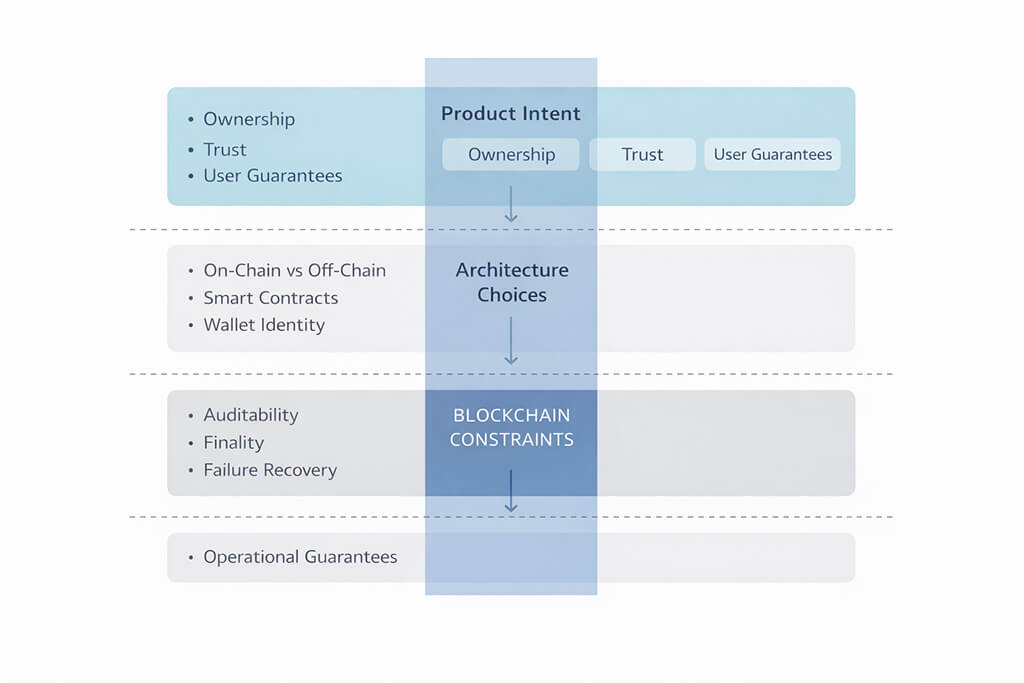
This setup is rarely one tool. It is a modular set spanning the Web3 frontend in JavaScript language and React, backend servers and databases, dApp frameworks – Hardhat library or Truffle, Ganache and other Web3 developer tools, signed interactions via wallet accounts and a path to the web via RPC and required APIs. The goal is to ensure that predictable functionality and a scalable rollout as your audience growing and transaction volume increases.
This is like blockchain networks infrastructure becomes part of the security assumptions. The same idea carries over to the world of Web3 with minimal changes. Treat each tier as a decision boundary developers reviews. In this post, we describe the different elements of the Web3 stack to demystify the Web3 app development process. So let’s start the developer’s guide to the Web3 stack.
A simplified definition of the Web3 structure
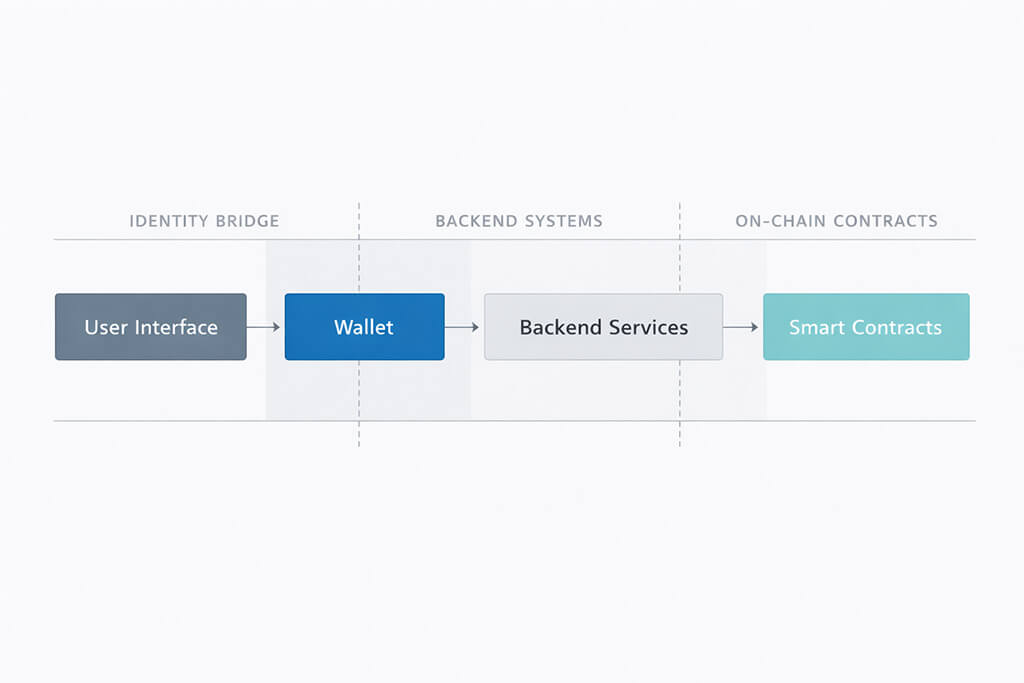
This is a developer’s guide to the Web3 stack, so we will cover technical aspects only in this article. Web3 applications are user-facing wrappers while applications define requirements and intent. A wallet is the identity anchor when a state moves across chains.
First is the experience edge: browser- or mobile UI, iOS wallet development or Android wallet development integration and user flows that make it intuitive to review intent and ensure signing and confirmation are clear. Second is the app tier: your Web3 backend services and API endpoints that enforce functional policies, cache reads and protect infrastructure. Third is the chain tier: smart contracts running in an environment where a virtual machine processes calls. Fourth is the data: indexing and analytics that turn in-protocol events into expertise features search, notifications and reporting.
What you gain in which relevant the Web3 tech stack is designed well
Well-defined ownership and portability. A wallet-based identity provides a consistent way to access products across environments. It also reduces reliance on password resets and centralized account recovery processes, though you must handle onboarding and education carefully. This is a common expectation in Web 3 products. That portability is strongest if a blockchain standard is widely supported by wallets and clients. It also gives a clearer way to size the scope before building.
Shared limitations and verifiable. Smart contracts development lets you encode constraints that are enforced by the chain. That is powerful for issuance, permissions and settlement response, provided your protocol-native process for smart contracts is tested with a suite that covers most of edge cases and security audits. Developers should document assumptions before refining edge cases. A Web 3 decentralized program can align blockchain networks infrastructure priorities with developer milestones, so dApps and wallet operational solution remain stable.
Composability. Web 3 stack and decentralized applications can connect to existing protocols and capabilities, including DeFi primitives and NFTs standards. That comes with integration complexity, but it can accelerate iteration cycles if you choose dependencies intentionally and your interfaces are stable. For regulated programs on blockchain technology, such as Ethereum, an audit trail is useful as requirements evolve. A Web 3 developer can build a minimal scenario on a sandbox node and then run it on a production node to observe effects through independent validation.
What changes compared to a typical Web2 blueprint
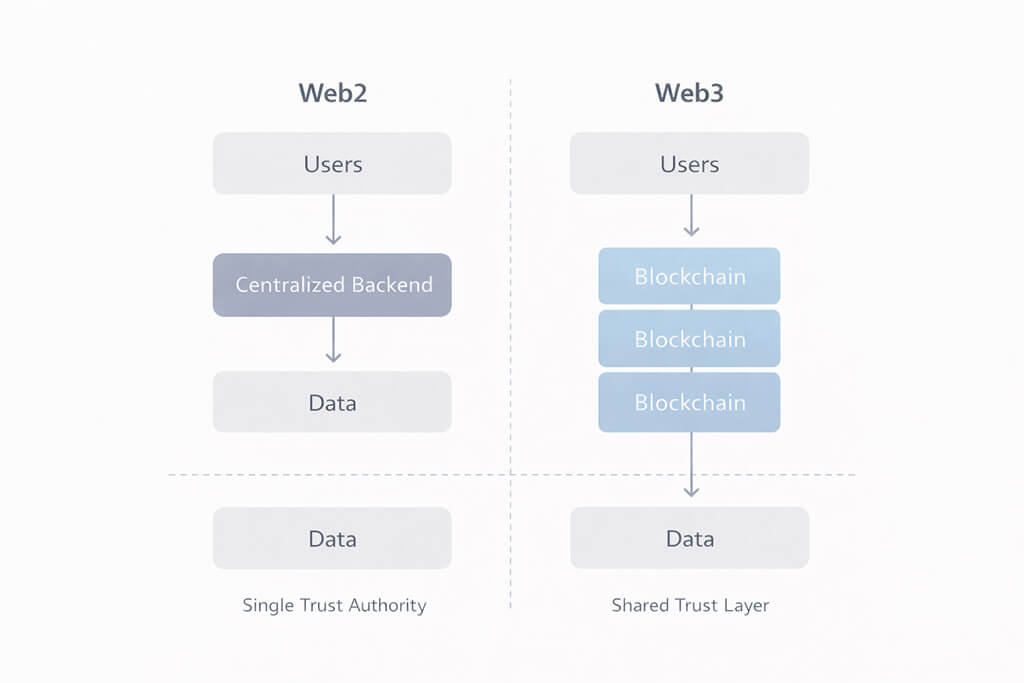
The core change is in which trust lives. In the Web2 apps, the backend owns the truth in solutions. In new dApps, consensus requirements become part of your trust boundary. That has implications. Many engineers start with blockchain network infrastructure to simplify control and governance. Partners often ask about EVM compatibility when evaluating integrations and custody options.
As a developer, you also inherit blockchain limitations, such as Ethereum network finality windows and fee volatility. The main change is that the blockchain workflow must treat wallets and transaction signing as first-class UX elements. This keeps data quality measurable. Add dApps guardrails early to prevent expensive rework, even in testnet.
Read operations often require index maintenance or caching, because core-protocol availability patterns are not optimized for iterative queries. Writes require signing and cost management since each change is a paid transaction. The network can be fast, but latency is variable and finality depends on the chain and its configuration. Small interface decisions can have a large downstream impact. In blockchains and dApps, the Ethereum release cadence can affect a blockchain.
What is a Web3 stack? Web3 development environment.
If cross-functional collections of Web3 workflow specs, the most popular problems come from blurred responsibilities. Web3 is not about using a set of Web3 development tools or copying a blog post example. Defining transparent roles and ensuring they interacting with the blockchain networks in a predictable way. In this way, it enables developers and companies to build scalable, robust decentralized services with security transparency.
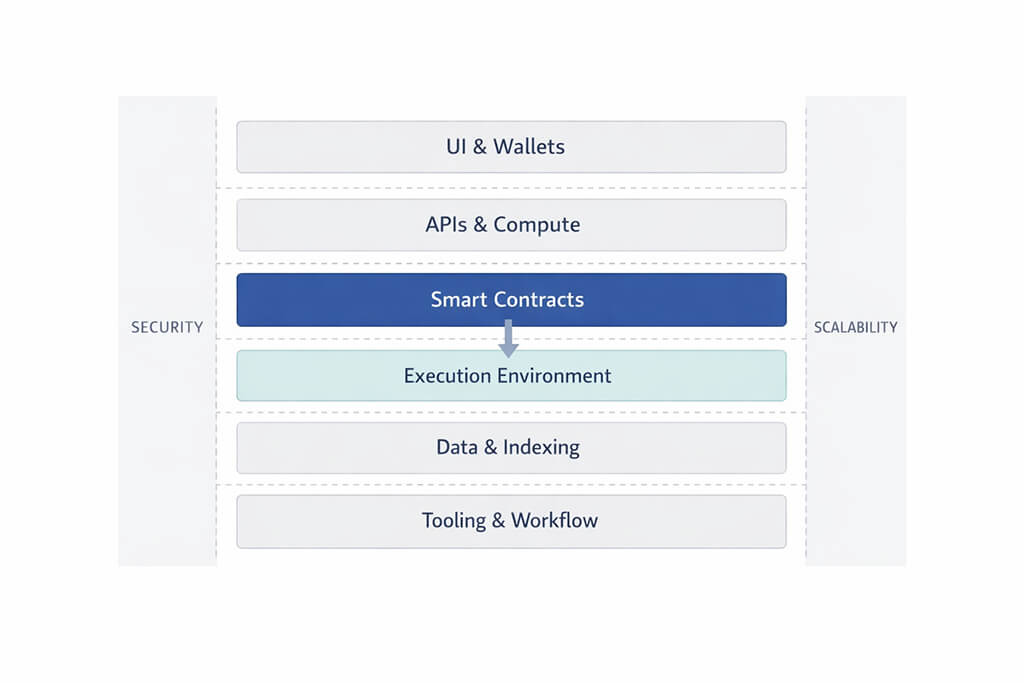
Developers can map responsibilities to details and make interfaces. Developers can treat each layer as a review gate to ensure the stack is coherent across Web3 dApps and APIs. Let’s now look at the different layers of the Web3 tech stack. In essence, the Web3 stack is made up of six primary layers, which are listed from bottom to top:
Layer 1: End-to-end track record, frontend stacks and wallets
The first class is how users interact with your platform. Two programming languages dominate the Web3 tech stack: JavaScript and Rust. This typically includes web interfaces built with JavaScript based React, iOS apps or Android apps, wallet connections and other tools that enable secure interaction with built-in control flow or AI. A seamless users experience and expertise here determines whether clients trust the offering enough to continue.
For developers, layering reduces coupling between the frontend, middleware and chain calls. Even user interface choices depend on blockchain latency and how confirmations are communicated. From a blockchain perspective, this is like trust signals and latency expectations are set.
In the infrastructure part of the Web3 stack, development benefits from strict interface boundaries between APIs and read-path solutions, enabling failures to be isolated. If an endpoint fails, route traffic to another node and ensure request tracing stays consistent.
This band is required to allow connecting wallets, signing messages, sending transactions and receiving obvious feedback. Whether you are working with cryptocurrencies and crypto exchange, NFT development, or other digital assets, the UI should hide unnecessary complexity while still providing transparent information on what is happening. A roadmap should include incident drills and storage recovery checks.
Layer 2: Web3 application compute tier and APIs
It’s a bridge between the frontend and new Web3 blockchain services and technologies. It is responsible for orchestrating interaction, validating inputs and enforcing policies that do not belong at the protocol level. This is APIs, authentication flows, rate limits and automation requirements live. Wallet prompts should reflect the real data the users are approving. This mindset supports shipping multiple coordination changes among builders and regional schedules.
Backend orchestration often hides complexity behind stable APIs. Good API boundaries reduce coupling between the UI and the backend. And for oracles too. This is where smart contracts reduce ambiguity. In practice, Ethereum network rollups change throughput assumptions while keeping familiar execution semantics.
Backend orchestration often hides complexity behind stable APIs. Good API boundaries reduce coupling between the UI and the backend. And for oracles too. This is where smart contracts reduce ambiguity. In practice, Ethereum network rollups change throughput assumptions while keeping familiar execution semantics.
Layer 3: Application layer of Web3. Smart contract based protocol guardrails-based responsibilities
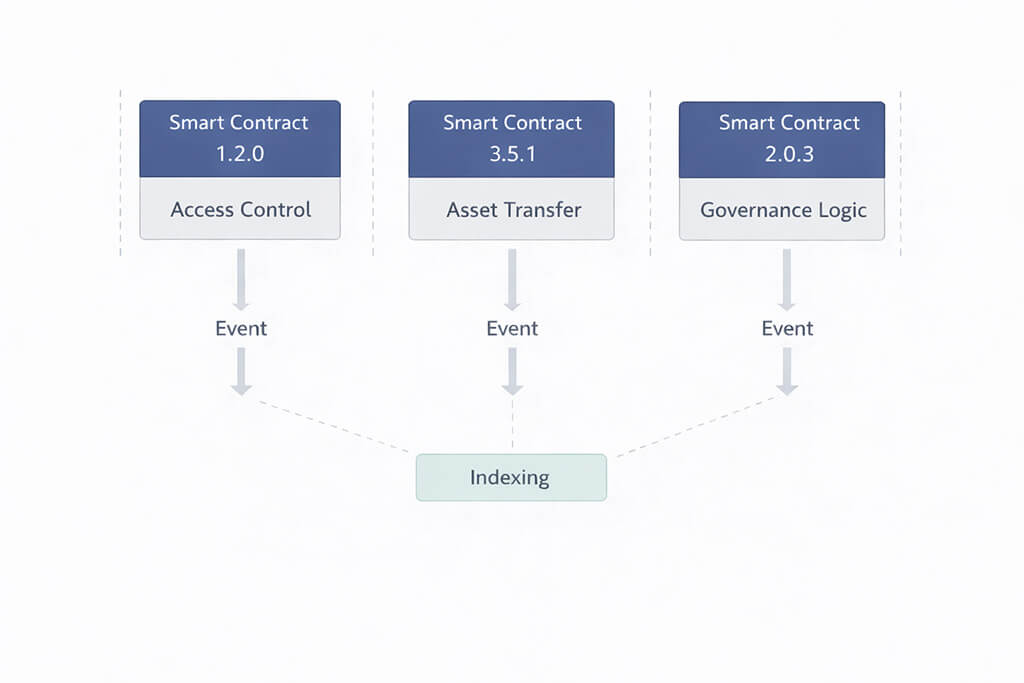
The spec-defined band is where smart contract modules and code written in Solidity or other supported languages enforce verifiable guidelines. These protocol-governed protocol flows define how tokens move, how permissions are checked and how changes are recorded on blockchains. This layer is where blockchain node state is defined and disciplined upgrades are applied. Interfaces should be versioned to enable safe upgrades.
Layer 4: Developer environment in the Web3 tech
At this layer, we define a strict network boundary and smart contracts should be isolated behind well-scoped call patterns.
Smart contract development executes inside environments such as Ethereum Virtual Machine-compatible networks like Polygon, Arbitrum, Polkadot, Avalanche and their mainnet, devnets, testnets. These dev environments determine how code is executed, how gas is calculated and how transactions propagate. Choices here affect performance, fees and lessons learned.
Caching is essential since Ethereum network reads are not optimized for deliverable queries. Read-path platforms commonly track Ethereum nodes logs to build queryable views for dApps. Off-chain compute must still respect data determinism at the boundaries. Environmental parity is a practical requirement for a new dApp, not a nice-to-have. This clarifies data retention.
Layer 5: Data, search indexing and disk systems
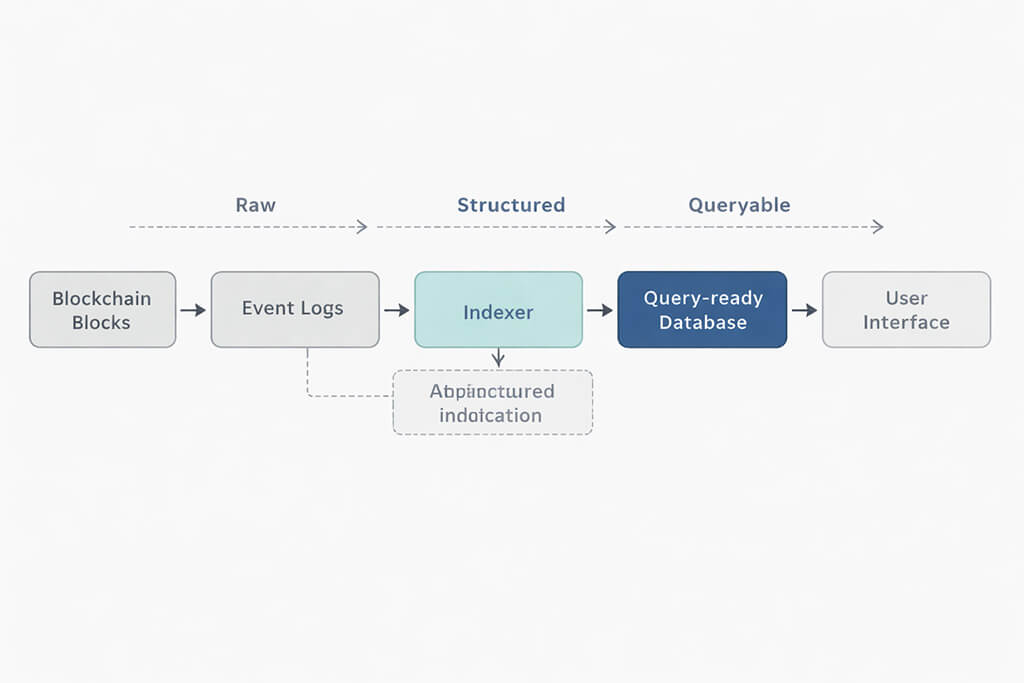
This requires data storage conventions that enable smart contracts to emit predictable events for downstream consumers.
Blockchain data storage alone is not enough to power modern decentralized applications. Products need query-optimized views, searchable histories and fast access to stored information. This category includes read-path databases and file system tools that subscribe and transform raw on-chain events into usable implementation data storage. Define observability as a deliverable so devs can trace intent through reads, writes and index refresh.
Analytics pipelines must reconcile node events with product telemetry. Indexing choices are often the biggest driver of cost and complexity. Smart contracts limits protect shared resources. Define blockchain node observability goals and alerts is a priority for developers.
Layer 6: Development environment in Web3. Programming languages, SDK, integration choices
What is the most effective tool for Web3 developers? Contributors choose a small set of programming languages for the primary paths and reserve the rest for glue and automation. Web3 tech stack: ultimate guide for Web3 development tools – JavaScript and TypeScript are common for clients, Python-based also has popular Web3 frameworks for scripts and analysis and Rust can be a strong fit to build performance-sensitive services, especially where crypto signing and verification are central. SDK selection matters because every blockchain has quirks in signing and encoding.
Choosing a Web3 ecosystem’s public SDK, like Hardhat or Truffle and proper documentation reduces integration risk for developers. This supports data portability in a new Web3 infrastructure. L1 public blockchains like Ethereum, Tezos, Solana, other blockchains and L2 illustrate why key management matters more than UI polish. For the infrastructure layer of the Web3 stack, the blockchain data storage migration plan should include parallel runs. For integrations, developers should prefer the smallest surface area that still meets product goals.
Top 3 Web3 Development Environments for 2026
Selected based on maturity, ecosystem support and developer productivity:
- 1. Hardhat
- Best for: Complex systems, upgradeable patterns and CI/CD pipelines.
Why it ranks: The de facto standard for professional development. Features advanced debugging (console.log), robust local blockchain and deep integration with JS/TS testing frameworks like Mocha and Chai. - 2. Foundry
- Best for: High-performance testing, fuzzing and gas optimization.
Why it ranks: A Rust-based toolchain built for speed. It excels at invariant testing and low-level control, making it essential for security-sensitive protocol work. - 3. Remix IDE
- Best for: Rapid prototyping, quick audits and education.
Why it ranks: A zero-setup browser environment. Ideal for “quick wins” — deploying directly to mainnet/testnet or running static analysis without configuring a local environment.
| Focus | What works well | Common risks |
|---|---|---|
| Client SDK types | Generated typings from ABIs and schemas, so errors are caught early and stay integrated into Web3 projects | Manual divergence makes debugging slow and makes reviews harder |
| Service boundaries | Small composable function wrappers around signing, serialization and retries | Hidden coupling that blocks upgrades and makes failures opaque |
| Automation and testing | Scripts that validate releases end-to-end, so maintainers can continue moving while being conservative on risk | Missing assertions that later become expensive incidents |
Web3 smart contract core-protocol pipelines and solution-level paths fundamentals

What smart contracts protocol-native components actually do in live deployments
Functionally, they serve as a shared system that multiple independent parties can interact with. This is why smart contracts protocol-enforced mechanics are so effective for ownership, settlement, IAM control and tokenized implementation between decentralized dApps and wallets. Blockchain apps are programs whose outputs are verified by every validator.
Web3 Terminology
Protocol-Defined Modules
Protocol-defined modules are programs deployed to a blockchain that execute deterministically. Unlike standard software, they serve as a shared, immutable system where multiple independent parties can interact with verified state changes. Enabling trustless ownership, settlement and Identity Access Management (IAM).
Development focuses on minimizing most of the edge cases and keeping state transitions readable. In capacity planning, Ethereum, Solana or other blockchains demonstrate how mempool pressure can reshape user costs. Web3 developers can create and validate assumptions about Ethereum, ensuring decentralized logic and wallet implementation solutions remain aligned.
Handling blockchains, components of Web3 technology stack, environments and why they matter
To better understand the inner workings of Web3 and the decentralized internet, let’s dive right into the Web3 developmer stack, suite of Web3 developer tools and infrastructure of the Web3 stack. The stack should describe how the network is selected per environment and how fallbacks are tested.
At the base of the Web3 technology stack is the blockchain network layer. Every program runs inside a compute tier provided by the blockchain. For Ethereum and other blockchains and compatible network development, use the EVM nodes, an EVM-compatible environment, or a non-EVM nodes. The virtual machine defines how code is executed, stored and priced. Write specifications first so blockchain mechanics are exposed before deployment. Validate the response and capture the returned identifier for support. View this compute tier as a deterministic computer with strict limitations on state and cost.
Recommended Web3 Release Workflow
Your development environment and tools should mirror the limits of blockchain architectures, such as gas limits and block times. Clear environment rules enable reliable development and testing on local and staging environments. This ties back to data indexing choices. During incident response, examples from Ethereum or Solana or other blockchains help explain congestion and delayed confirmations. Developers should isolate risky changes behind clearly labeled entry points and fix them step by step, then compile test, debug and deploy.
Defining the Web3 app boundary between the core protocol and the off-chain plane response
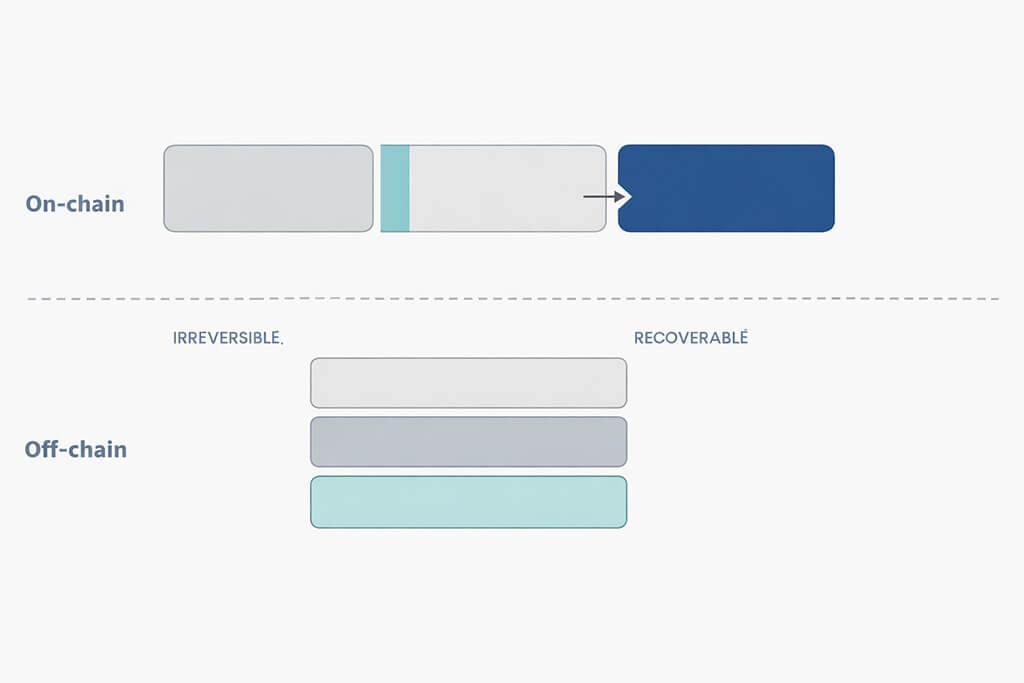
In Ethereum, Solana, or other blockchains, when creating a smart contract, every developer starts with assumptions. New contracts should assume callers may be malicious, transactions can be reordered and external calls may fail or behave unexpectedly. Developers run a brief review checklist before shipping changes that affect keys, permissions, or user-friendly flows. Operational readiness should be planned in layers within the Web3 stack and its features. Security audits should assume an adversarial blockchain where anyone can call functions. A written threat model accelerates reviews and makes them more objective. This reduces surprises in data storage handoffs. Developers can build a rollout plan on a canary node and then replicate it on other blockchain nodes, so users see decentralized safeguards such as gradual activation.
🛡️
Critical Security Assumptions for 2026
When defining the app boundary, developers must assume the environment is adversarial. Do not ship code without accounting for these three threats:
- Malicious Callers: Any function exposed to the network will be called by bad actors.
- MEV & Reordering: Validators may reorder transactions for profit; your logic must be order-independent.
- External Failure: Calls to other contracts or oracles may fail silently or behave unexpectedly.
Web3 tech stack overview – infrastructure, decentralized storage and scaling considerations

RPC access, nodes and provider reliability
Developers know that every crypto and Web3 application depends on network access. This access is typically provided via Remote Procedure Call (RPC) endpoints, which allow applications to read the blockchain and submit signed transactions. Relying on a single endpoint is risky. Rate limits, regional outages, or provider incidents can immediately impact user hands-on practice. Ethereum endpoint redundancy reduces the blast radius of rate limits and outages.
Build fallback services for Remote Procedural Calls so users traffic degrades predictably during outages. RPC strategy directly impacts blockchain reliability because reads can degrade under load. Provider SLAs and rate limits should be treated as development constraints from day one. This keeps operational data and transactions readable.
Designing separate paths for reads and writes
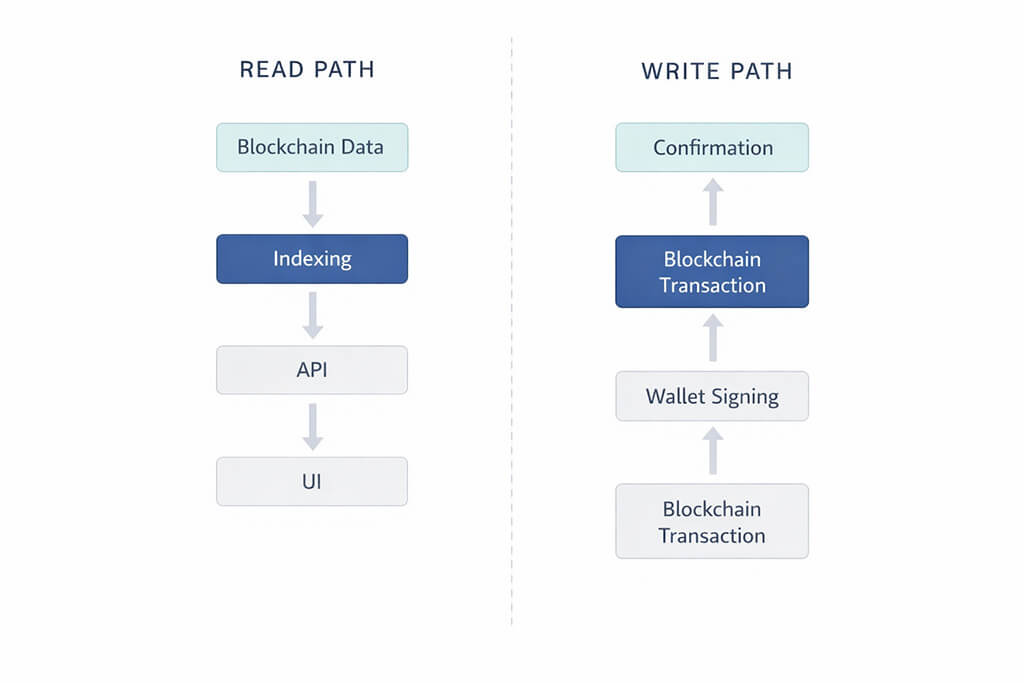
When defining the Web3 tech stack, we must note that a scalable blockchain application stack treats read and write operations and transactions as fundamentally different. Reads can often be served from query-ready databases. Writes involve signing, smart contracts and gas estimation, optimization, nonce processing and uncertainty around confirmation latency. Mixing these concerns leads to brittle pipelines and confusing product know-how.
Rate limits and retries should be tuned to blockchain latency and finality. Pin on-call runbooks to each node so on-call can map symptoms to the right providers like Metamask. Separating reads and writes simplifies caching and retries. Access policies minimize privileges. A blockchain audit trail and data retention discipline support compliance and a requirement in highly regulated countries like the US or the European Union.
Search indexes, databases and production data frameworks
Raw in-protocol data is powerful but not directly usable for most platform features. Indexing pipelines transform blocks and events into structured information that applications can query efficiently. This query-ready data is typically stored in databases optimized for read performance and flexibility. Even minor ambiguity can lead to costly incidents. Indexers translate raw blockchain logs into queryable product data.
A narrow indexing plan can unlock development speed without sacrificing observability. This makes incident data easier to correlate. Metrics matter most when tied to customer-visible outcomes. For a developer, Ethereum client updates should be tested against your staging blockchain settings.
Content-addressed data storage and permanence tradeoffs
If you want assets to be available in regions without a central gate, content-addressed networks are often the simplest option. IPFS file storage is a peer-to-peer (p2p) node that supports decentralization by making retrieval based on content hashes, while Arweave focusing on long-term persistence with a different economic structure. This is one of the simplest improvements you can make quickly. This encourages clean interfaces. Developers build an observability note on a monitored services and then cross-check it on other nodes to help users interpret decentralized signals, such as noisy metrics.
Monitoring dashboards fall within the development scope because they translate metrics into actionable steps. Blockchain, like Ethereum, helps include failures in everyday reviews. dApps rollbacks reduce downtime risk.
Scalability, performance and user experience expectations
At this layer, optimize the stack by measuring end-to-end latency and by validating the network bottlenecks under peak load. A blockchain security review should be scheduled on every release with smart contract sign-off rules.
Scalability is less about raw throughput and more about managing variance. Network congestion, fee spikes and delayed confirmations are normal. A well-designed spec anticipates these conditions and communicates them clearly. Metrics should include Ethereum nodes latency percentiles and confirmation latency distributions. Performance budgets should be agreed upon during development, not after production pain.
Observability, monitoring, operations and transactions

Operating a Web3 platform requires visibility over all components for the best users experience. Implementers need to trace user actions from frontend interaction through backend services, RPC calls and transaction submission. Logs, metrics and alerts should be treated as core setup components, not optional add-ons. At each layer, define a small set of signals. Operational dashboards should correlate blockchain congestion with user experience. This keeps governance policy aligned with users expectations. For production rollouts, Ethereum is a strong reference for operational maturity and Web3 ecosystem maintain.
Web3 stack: a comprehensive guide, conclusion – building the best blockchain layout in 2026
In 2026, a startup does not win by quickly adding software features for users. They win by building a system that remains stable when the network is slow, fees spike, or usage demand surges. A dependable blockchain, like Ethereum, service blueprint is not a single framework, Web3 libraries or provider. It is an end-to-end design that integrates users’ lessons learned, compute environment components, smart contract base-protocol components and infrastructure into a coherent operating Web3 framework and data services.
If you can describe what each layer owns and how it fails, you can harden reliability without slowing down releases. A mature plan treats blockchain integration as product engineering, not a hack. Developers can use the checklist below as a final sanity check. Developers will iterate faster if each layer in the Web3 stack has an owner and measurable outcomes. Developers can build on a local node first, deploying in devnet, then scale to multiple nodes to validate assumptions about decentralization. At this point we are at the end of a comprehensive guide to the Web3 stack for developers.
In the next article we will dive deep into Web3 marketing playbook and Web3 community tools.
Web3 Development Glossary of Terms
Frequently Asked Questions about Web3 Development Stack
What are the 6 layers of the Web3 stack?
The Web3 stack consists of six primary layers: 1) Frontend and Wallets, 2) Compute Tier and APIs, 3) Smart Contracts and Protocol Guardrails, 4) Developer Environment (EVM/Testnets), 5) Data Indexing and Search and 6) Development Tools (Languages and SDKs).
How does Web3 architecture differ from Web2?
The core difference is the trust boundary. In Web2, the backend server owns the truth. In Web3, consensus and wallets form the trust boundary, writes require gas and signing and data ownership is portable via the blockchain.
What are the top Web3 development environments for 2026?
The top environments are Hardhat (best for complex systems and CI/CD), Foundry (best for high-performance testing and gas optimization) and Remix IDE (best for rapid prototyping and quick audits).
Why must read and write paths be separated in Web3?
Writes involve signing, gas estimation and confirmation latency, whereas reads can be served instantly from query-ready databases. Separating them prevents brittle pipelines and ensures predictable user experiences.
FAQ
Quick answers to common questions about custom software development, pricing, process and technology.
Type to filter questions and answers. Use Topic to narrow the list.
Showing all 6
No matches
Try a different keyword, change the topic, or clear filters
-
A Web3 technology stack in 2026 consists of six layers: blockchain protocol (Ethereum, Solana, Cosmos), smart contract language (Solidity, Rust, Move), indexing and data layer (The Graph, custom subgraphs), off-chain storage (IPFS, Arweave), application layer (React + ethers.js/wagmi) and infrastructure (RPC nodes, oracles, bridges). Unlike Web2 stacks where you control the database, Web3 stacks split read and write paths – reads go through indexers while writes go through transaction signing and on-chain execution.
Learn more: Web3 Stack Definition Opens in the same page.
-
Foundry is the recommended choice for new projects in 2026. It compiles faster, runs Solidity-native tests (no JavaScript context switching), has better gas reporting and supports fuzz testing natively with Echidna integration.
Hardhat remains relevant for projects requiring JavaScript-based testing, existing Hardhat plugin ecosystems or teams with stronger TypeScript expertise. Pharos Production uses Foundry for all new smart contract projects and Hardhat for maintaining legacy codebases.
Learn more: Hardhat Vs Foundry Opens in the same page.
-
IPFS is a distributed file system where content is addressed by hash but requires active pinning to stay available – if no node pins your data, it disappears. Arweave provides permanent storage with a one-time payment model, guaranteeing data availability through its blockweave architecture.
Use IPFS for mutable content that needs updates (via IPNS) and Arweave for immutable assets like NFT metadata, legal documents and audit trails. Most production dApps use both: Arweave for permanent records and IPFS for frequently accessed content via Filecoin incentivized pinning.
Learn more: Ipfs Vs Arweave Opens in the same page.
-
Smart contract security requires a layered approach: static analysis with Slither to catch common vulnerabilities, fuzz testing with Echidna to explore edge cases with 10,000+ random inputs, formal verification with Certora for functions handling value transfers above $100K, and independent third-party audits from firms like OpenZeppelin or Trail of Bits before mainnet deployment. After deployment, we implement monitoring with Forta agents for real-time anomaly detection and upgrade contracts via UUPS proxy patterns with 48-hour timelocks and multi-sig governance.
Reference: Smart Contract Security
-
The fundamental difference is the trust model. In Web2, users trust the server operator.
In Web3, trust is enforced by cryptographic proofs and consensus mechanisms. This changes everything: state is on-chain and immutable (bugs cannot be hotfixed), reads and writes are separated (reads via indexers, writes via signed transactions), authentication uses wallet signatures instead of username/password, and data storage uses content-addressed systems instead of centralized databases. Development cycles are longer because deployed smart contracts are permanent – every function needs extensive testing before deployment.
Learn more: Web3 Vs Web2 Opens in the same page.
-
Yes. Pharos Production delivers full-cycle Web3 development from smart contract architecture through front-end dApp interfaces.
Our team has shipped 15+ blockchain projects since 2018 across DeFi protocols, NFT marketplaces, crypto wallets and DAO governance systems. We deploy on Ethereum, Polygon, Arbitrum, Optimism, Solana and 15+ other chains. Every project includes smart contract security audits, gas optimization and production monitoring setup. See our Web3 case studies including Kimlic (blockchain KYC), Ludo (reputation platform) and PumpTap (crypto wallet).
Learn more: Pharos Web3 Services Opens in the same page.


